Why a rainbow has a circular shape
A rainbow is made by sunlight reaching your eyes after passing through many separate raindrops. In each drop, light bends as it enters, reflects once inside, then bends again as it leaves. The drop sends different colors toward your eye at slightly different angles; for the brightest part of the primary rainbow, those angles are about 40 to 42 degrees from the direction opposite the Sun.
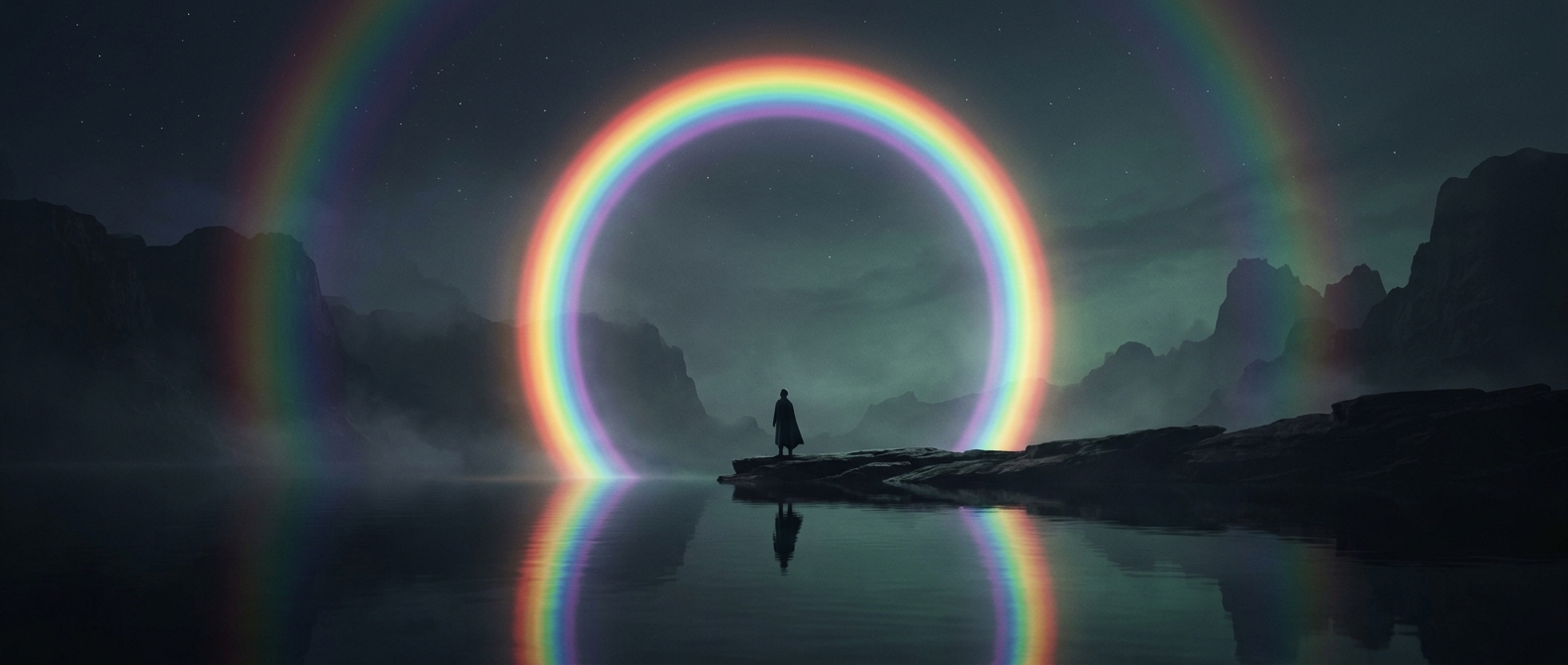
That angle sets the shape. Drops at the right angle can appear anywhere around a line running from the Sun through your head and onward into the sky. The line’s far end is called the antisolar point. The rainbow forms a circle centered there, with the observer at its center.
Why we usually see only an arch
From the ground, the lower half of that circle falls below the horizon—or behind nearby terrain. The visible arc can rise higher when the Sun is low, because more of the circle clears the horizon. With the Sun high, the circle sits lower, and only its top may be visible.
The ground is not the only obstruction. From an airplane, a high mountain, or above a sunlit spray, there may be no horizon blocking the lower part, so a full circle can sometimes be seen. The rainbow is not a fixed object hanging in one place: its droplets must send light to a particular observer’s eyes. Move, and the set of drops contributing to the circle changes. The circle is complete in the geometry; the view depends on what blocks it.