Why a floating mountain can suddenly roll
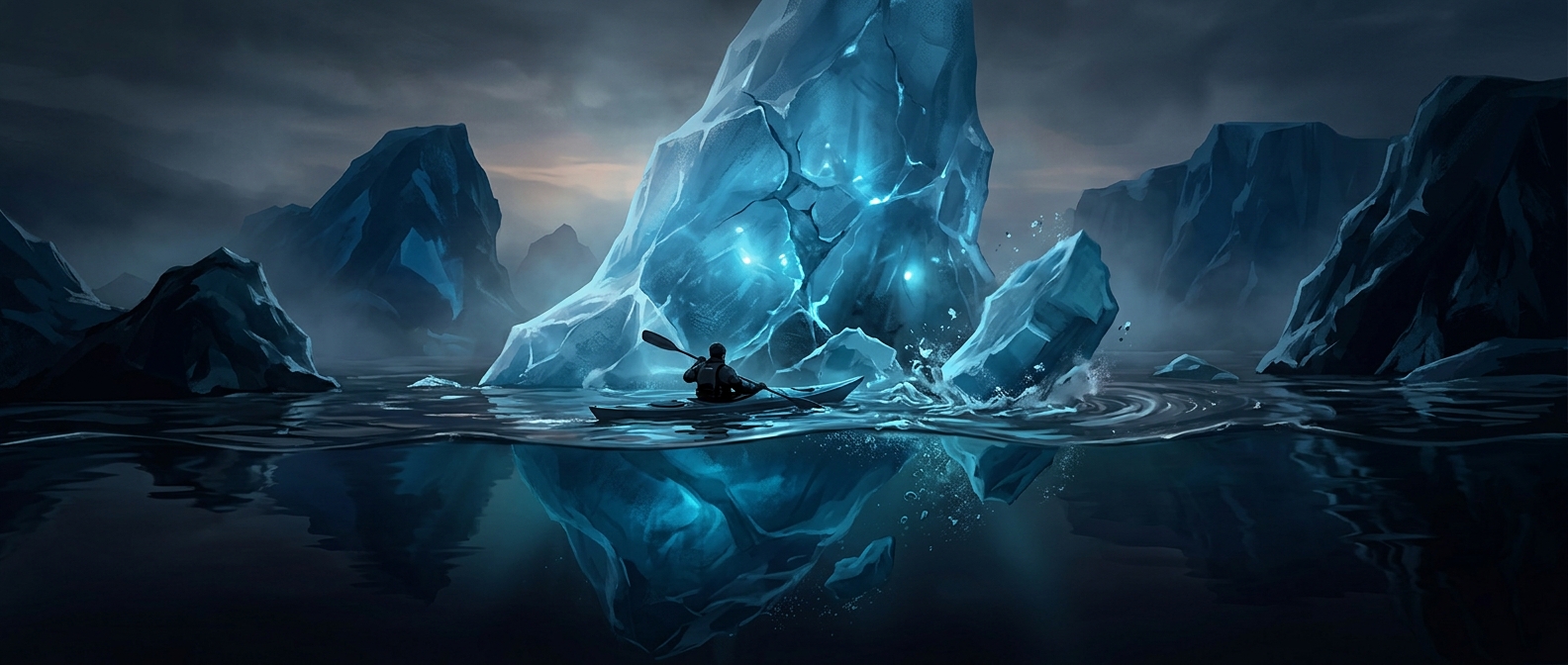
An iceberg floats because the water it displaces weighs as much as the iceberg itself. Since ice is less dense than seawater, most of the ice sits below the surface. That hidden bulk makes an iceberg’s balance hard to judge from a kayak: the visible tip is only a small part of the structure.
An iceberg stays upright while its weight and the upward push of the water balance around its center. But that balance can change as the ice melts unevenly, breaks apart, or loses a large chunk. A crack may release a section that was holding the berg in a particular position; once the weight shifts, the iceberg can rotate until it finds a new stable orientation. Water rushing around and beneath the moving ice adds to the disturbance.
A close view comes with a moving hazard
In a sheltered glacial lagoon, kayakers may paddle among icebergs because the water brings them within view of the ice’s ridges, fractures, and blue-green surfaces. Yet the part that looks calm from the surface may be attached to a much larger, unstable mass below. A flip can send waves outward and scatter smaller pieces of ice, so the danger is not limited to the berg itself.
That is why a seemingly motionless iceberg should not be treated like a fixed landmark. Its visible shape can offer little warning of how its submerged mass is balanced—and a sudden change can turn a quiet stretch of water into a moving field of ice.