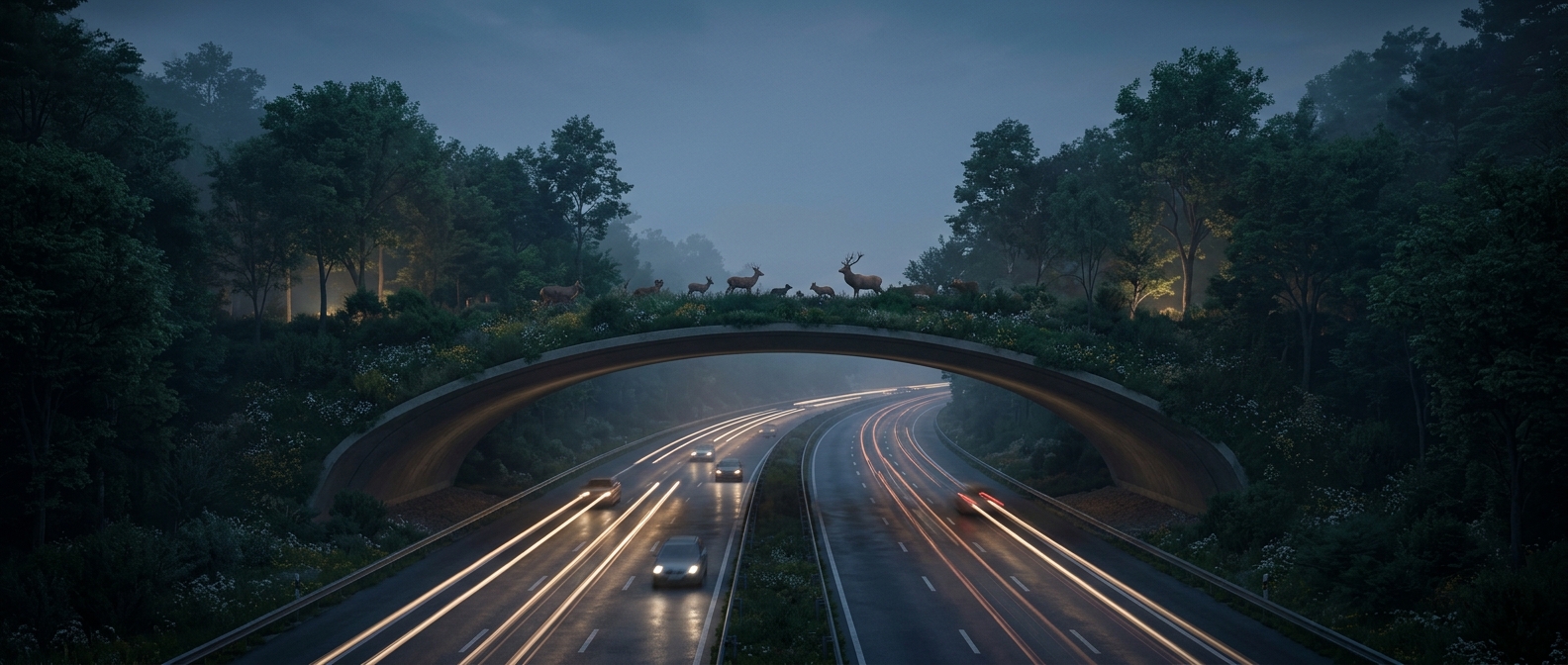
Why a wildlife bridge needs more than plants
A vegetated overpass works only if animals can reach it and feel safe crossing it. Roads create a hard break in habitat: an animal moving between feeding, shelter, or breeding areas may face traffic, noise, lights, and open pavement. A bridge replaces that risky gap with a route across the road, but its design has to make the route usable to wildlife—not merely passable to people.
The surface is built up with soil and planted to resemble the surrounding habitat. Depending on the location and the animals it is meant to serve, designers may use native grasses, shrubs, or trees. These provide familiar cover and food, while soil and vegetation soften the exposed, engineered feel of a bare concrete deck. Barriers along the edges can reduce the sight and sound of traffic below.
Making the crossing part of the landscape
The bridge is only one piece of the system. Fences can guide animals toward its entrances and discourage them from entering the road elsewhere. Without those connections, an overpass may sit above a highway while animals continue to approach the dangerous pavement at ground level. The paths leading to each end therefore need to connect with habitat on both sides, rather than funneling animals into a dead end or a developed area.
Design also involves tradeoffs. A broad, planted crossing can accommodate more kinds of movement and provide a less exposed route, but it requires land and construction resources. The best vegetation and layout depend on local species and terrain; a route suited to one landscape may be uninviting in another. Even a well-designed bridge does not make every animal use it or prevent every collision.
Its larger value is continuity. When animals can move between separated patches of habitat without crossing fast traffic, they have a safer way to reach resources and mates. The bridge turns a highway’s sharp divide into a passage that, from the animal’s side, can feel like an unbroken stretch of ground.