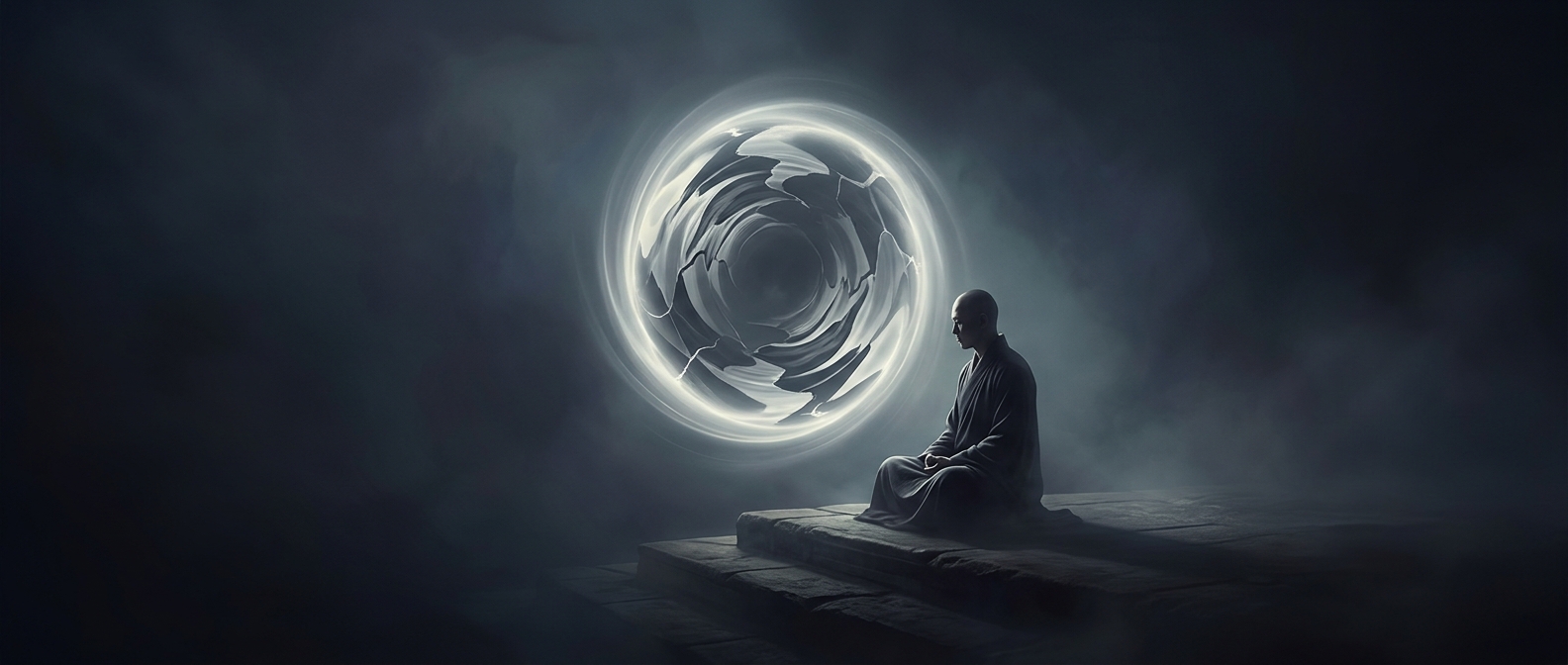
The Fear That Turned Ramana Maharshi Inward
At about 16, Ramana Maharshi later recalled being suddenly overcome by the fear that he was dying. Rather than seek help or try to distract himself, he lay down, held his body rigid, and imagined it as a corpse. He then examined what death would mean: if the body stopped moving and speaking, what was the “I” that knew this was happening?
The episode is often described as a spontaneous spiritual awakening. The key point in Ramana’s own account is not a special breathing technique but the direction of his attention. He treated the fear as a question to investigate, following the sense of “I” rather than the body’s apparent stillness.
What “Self-Inquiry” Means
Ramana later taught a practice known as self-inquiry: when a thought or feeling arises, ask who is experiencing it, then attend to the felt sense of “I” instead of chasing the thought’s content. The inquiry is meant to expose what he regarded as the source of the separate, personal self—not to produce a clever answer or replace one thought with another.
In his nondual understanding, the deepest “I” is not the personality or the physical body. It is the underlying awareness in which bodily sensations and thoughts appear. “Nondual” means that ultimate reality is not divided into a separate observer and everything observed. This is a religious and philosophical claim, not a conclusion established by the episode as a scientific experiment.
A Personal Crisis Became a Teaching
Ramana’s account does not describe a method he developed by comparing himself with other yogis, nor does it establish that breath-holding or simulated death is required. The striking feature is how an immediate fear became an inquiry into identity. He later made that inquiry accessible as a contemplative practice, directing people back to the ordinary question “Who am I?” rather than to elaborate ritual.
The lasting implication is simple but demanding: instead of asking only what a thought says, self-inquiry asks who is aware of it.