Why a Suspension Bridge Moves in Wind and Earthquakes
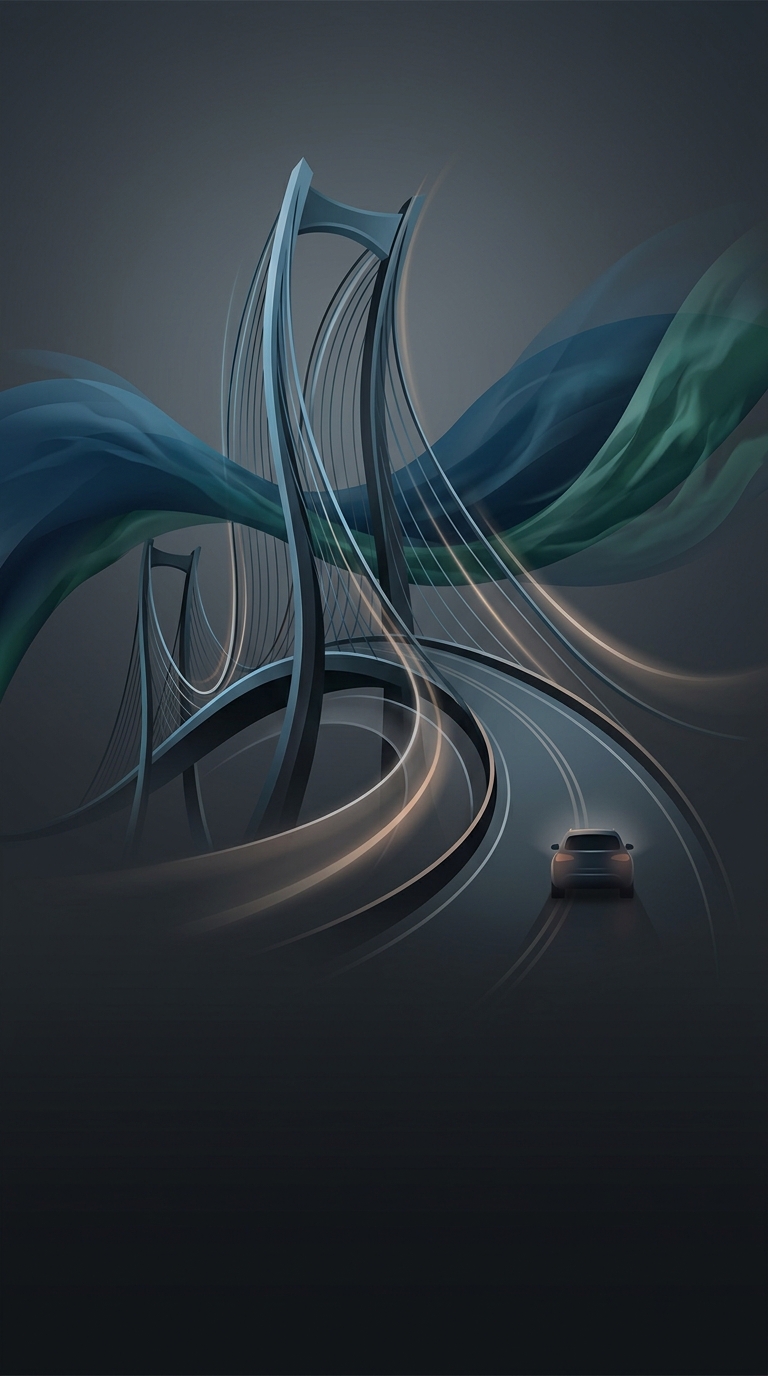
A suspension bridge cannot be made perfectly rigid. Its long roadway, or deck, must span a wide gap while carrying traffic, and the cables supporting it must accommodate changing loads and temperatures. Engineers therefore design the structure to move within controlled limits rather than trying to prevent every bend or sway.
In a crosswind, air pushes on the deck. The deck’s flexibility lets it shift and bend instead of forcing the wind’s full load into one brittle point. Vertical hangers connect the deck to the main cables, which carry much of that load toward the towers and anchorages. The bridge’s movement is not simply harmless looseness, though: engineers calculate how the deck and cables respond to wind and add features such as dampers to reduce unwanted motion.
Movement Must Be Controlled, Not Just Allowed
A bridge can become unsafe if wind-driven motion grows instead of settling down. In a phenomenon called flutter, wind and the bridge’s movement can reinforce each other, producing increasingly large oscillations. Engineers study how air flows around a proposed deck and design its shape and structural damping to prevent that feedback. So visible motion alone does not prove a bridge is in danger—but neither does flexibility make every amount of motion safe. Bridges are designed and monitored to remain within specified limits.
Earthquakes pose a different challenge. Some bridges use bearings—components between the deck and its supports—that allow controlled movement, along with dampers that absorb energy. These features can reduce the forces transmitted through the structure as the ground shifts. The specific design varies by bridge; wind flexibility and earthquake movement are related ideas, not the same response.
That distinction explains the useful principle behind a swaying span: the goal is not to keep a bridge motionless, but to keep its motion predictable and bounded. A deck that can yield to changing forces can avoid concentrating all that stress in a single rigid connection.