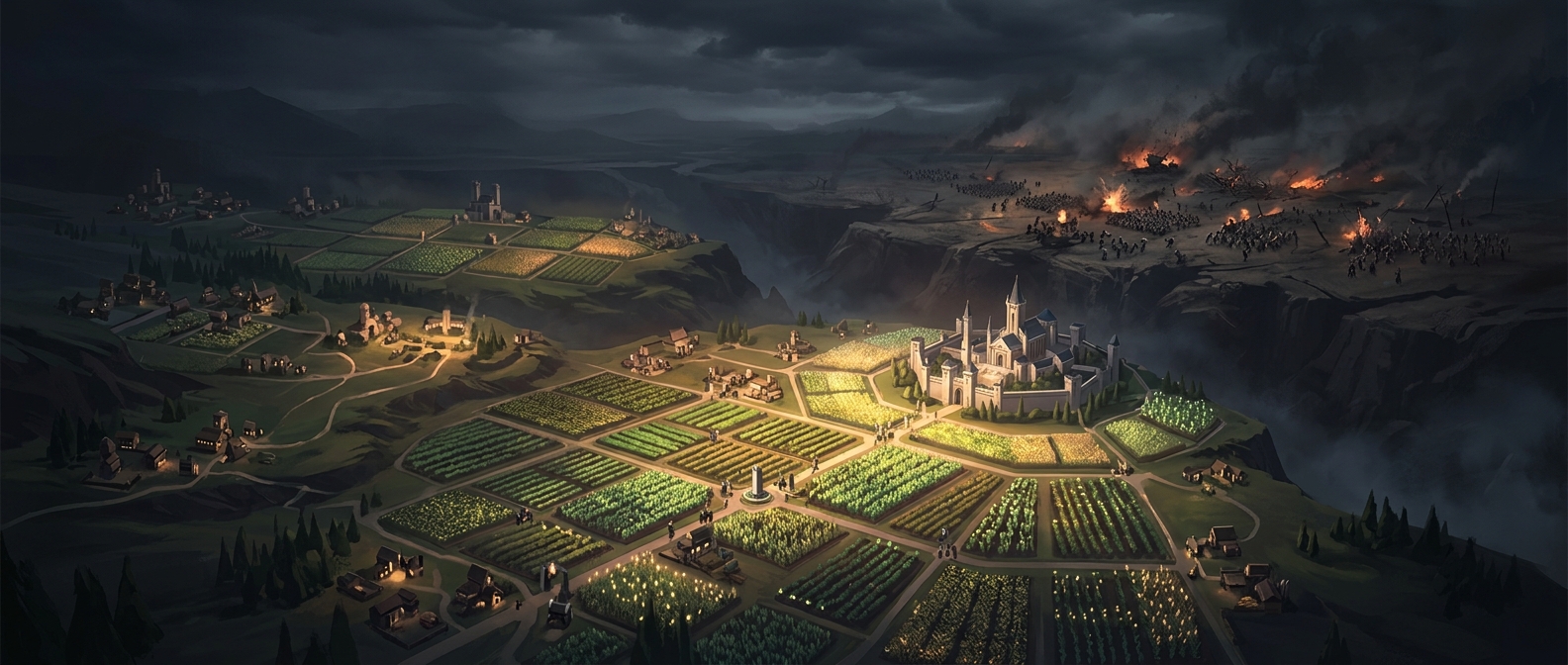
Why farms can matter more than a clean victory
In many strategy games, a battle is only one exchange in a longer contest. Farms help support that contest by supplying food, population capacity, or another resource needed to field an army. Their value is easy to miss: they may not defeat an enemy unit directly, but they can determine how many units a player is allowed to build and how quickly losses can be replaced.
The compounding effect of a stronger economy
A player who spends resources on farms may have fewer troops at first. But once that investment pays off, the player can keep production running while an opponent is still rebuilding after a costly fight. Fresh units arrive in waves, turning a small early advantage into a larger force over time.
That is the logic behind macromanagement: planning the economy, production, and army across the whole match, rather than focusing only on the units currently fighting. Micro-management—controlling individual units moment by moment—can win an encounter. Macro-management can make sure there are enough units for the next encounter, and the one after that.
When the investment pays off
Farms are not automatically better than troops. If an opponent attacks before the economy can grow, spending on infrastructure may leave a player exposed. A farm also helps only if the game’s rules make its resources or capacity useful, and if the player can turn that advantage into units in time.
The tradeoff is between strength now and the ability to sustain strength later. A player who wins one battle but cannot replace losses may eventually be worn down by an opponent with steady production. In that kind of match, the decisive advantage may not be the army that wins the first fight, but the economy that can send another one.