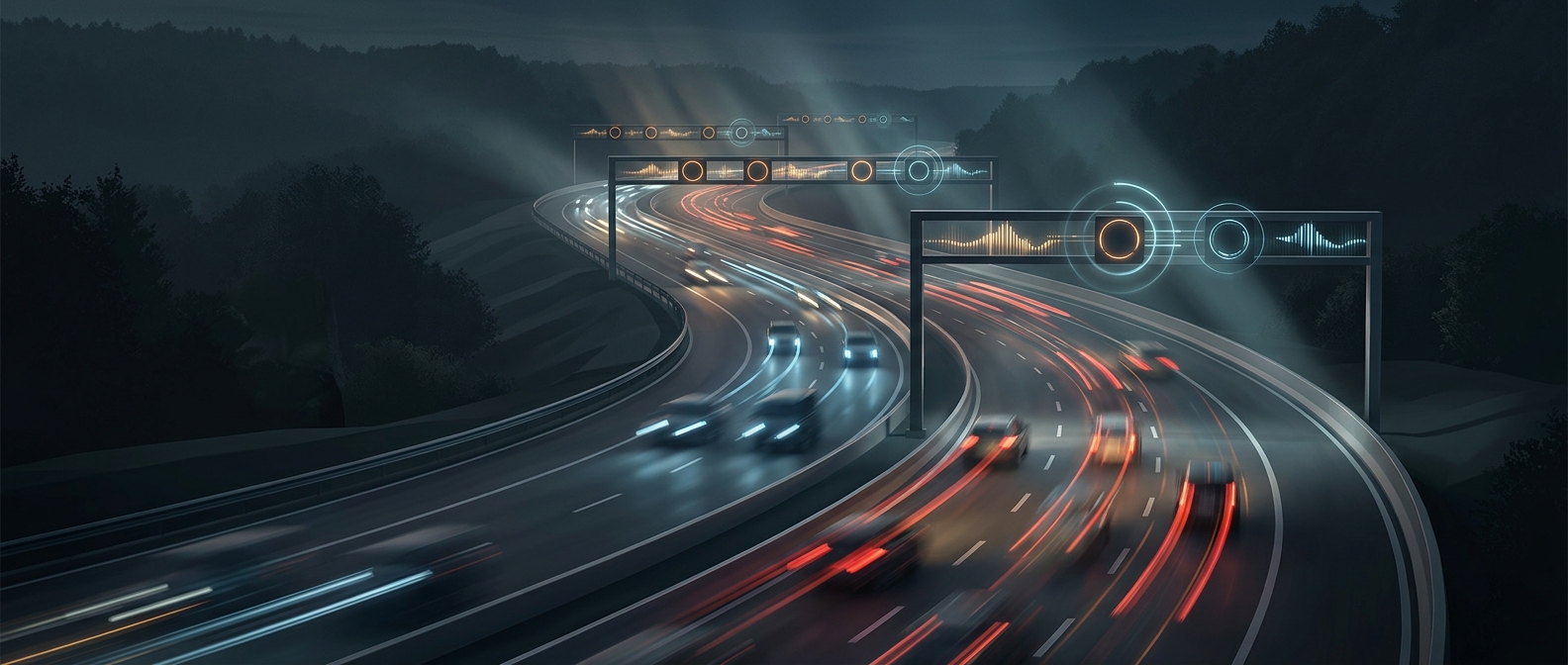
Why a highway speed limit can change mid-journey
Germany’s variable speed limits are used on equipped stretches of road, not across every autobahn. Their purpose is to respond to conditions that a fixed sign cannot anticipate: a sudden slowdown, poor visibility, rain, or another hazard can make the same speed safe at one moment and risky at the next.
Smoothing the traffic before it becomes a jam
A small disturbance—a driver braking, a vehicle changing lanes—can ripple backward through fast-moving traffic. Each driver brakes a little harder than the one ahead, and soon a slowdown has formed even though there may be no obstacle in the road. Lowering the permitted speed upstream gives drivers more time and space to react, reducing abrupt braking and the sharp differences in speed that can turn a minor disruption into a queue.
Weather creates a different problem. Wet pavement reduces tire grip, while fog or spray can shorten the distance at which drivers see trouble. A lower limit cannot restore traction or visibility, but it can make stopping distances and reaction time less unforgiving.
The sign is part of the control system
Roadside sensors provide information about traffic and conditions; a control system uses it to select a displayed limit on electronic signs. The posted number is therefore a real instruction, not merely a suggested pace. When conditions improve, the system can raise it again, avoiding the need for a permanently low limit on a road that is often clear.
The practical tradeoff is between flexibility and surprise: drivers must notice that the sign has changed and adjust promptly. In return, the road can be managed for the conditions actually unfolding—sometimes slowing traffic before a brake-light wave reaches the next bend.