How a jet stream can hold a six-sided shape
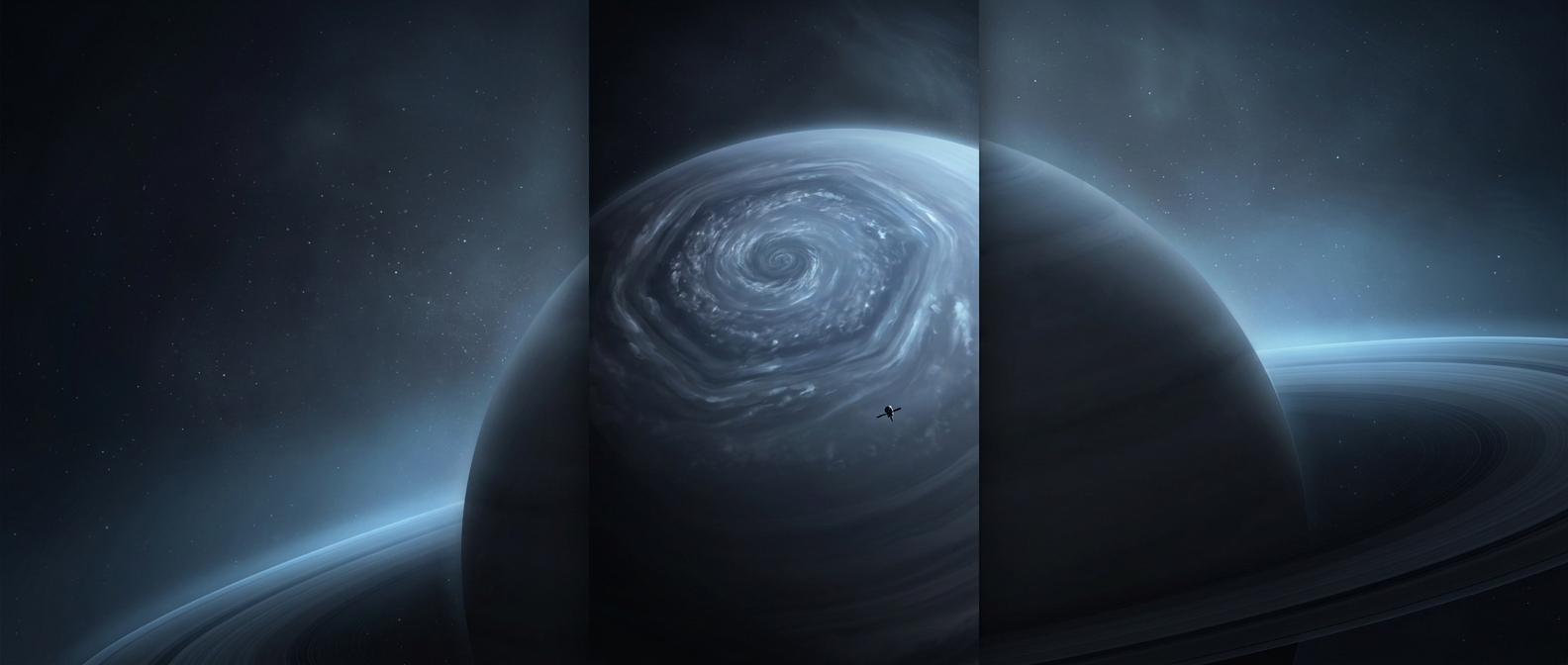
Saturn’s north-polar hexagon is not a solid boundary or a storm wall. It is a pattern traced by clouds moving through a fast atmospheric current. The current circles the pole, and its path bends into six broad corners instead of settling into a smooth circle.
The key is a planetary wave: a large-scale wobble in moving air, shaped in part by the planet’s rotation. As the jet flows around Saturn, the wave can steer it repeatedly inward and outward. When the bends line up around the pole, the jet’s edge takes on a polygonal outline.
Why the corners do not simply wash away
Air currents tend to smooth out sharp bends. A wave can counter that tendency by continually organizing the flow into a repeating pattern. In Saturn’s case, the rotating atmosphere and the jet provide conditions in which a six-lobed wave can persist, keeping the corners in place as clouds stream along the current.
The clouds make the shape visible, but they are not the cause in the way bricks make a wall. They are tracers—features carried by the moving air—so the hexagon reveals how the atmosphere is flowing beneath them. Without the wave pattern, the jet would tend toward a more rounded path.
That distinction makes the hexagon more than a striking outline: it is a visible clue to the balance between a jet’s tendency to smooth out and the atmospheric waves that keep reshaping it. On a planet, wind can draw a geometric form without any fixed structure to draw around.