Why Pluto’s Ice Makes Both Mountains and Glaciers
On Earth, “ice” usually means frozen water, so it is easy to imagine all ice behaving alike. Pluto’s surface is different: several substances freeze there, and their mechanical properties vary. Water ice is exceptionally rigid in Pluto’s deep cold. At the temperatures found on the dwarf planet, it can resist deformation well enough to form the sturdy framework of steep peaks.
Nitrogen ice is much softer under those same conditions. It can slowly deform under its own weight, a process called creep. Over time, gravity pulls the nitrogen ice downhill and around obstacles, much as it moves a glacier on Earth. The motion is gradual, but it means Pluto’s surface is not simply a frozen landscape locked in place.
A Landscape Built From Contrasts
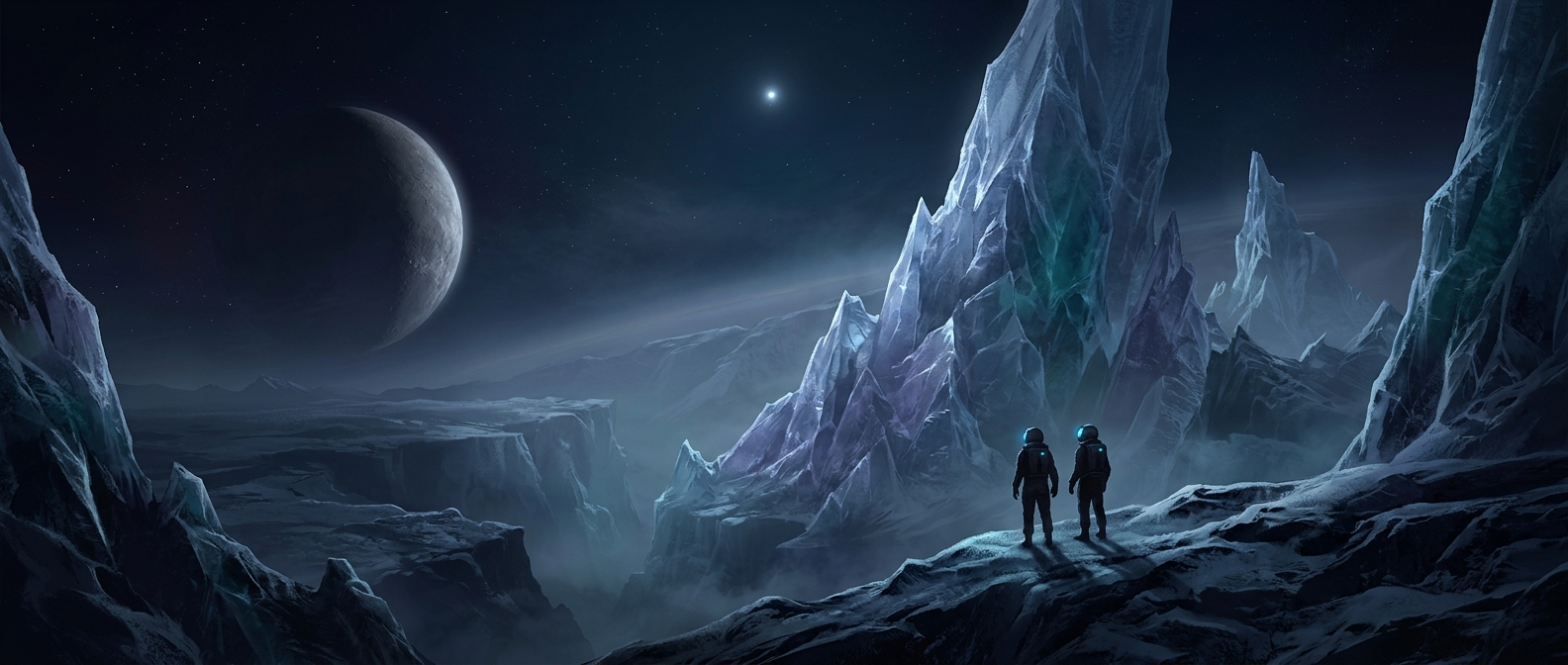
The difference in strength lets the two materials play distinct roles. Water ice holds up the high ground; nitrogen ice can move through lower areas and collect around the mountains’ bases. The result is a landscape where solid-looking peaks rise from material that can flow, even though both are frozen.
That contrast also explains why Pluto’s mountains need not be carved from a hard mineral rock. Their “bedrock” can be water ice, while the surrounding nitrogen ice behaves more like a slow-moving glacier. On Pluto, what a frozen landscape can do depends on which substance froze—not just on the fact that it is ice.