A city built in layers
At Hisarlik, in what is now northwestern Turkey, the remains of one settlement sit on top of another. Over centuries, people rebuilt after destruction, changed buildings, and raised new structures over older debris. Archaeologists call each period of occupation a stratum: a layer whose objects and construction can help establish when people lived there.
That arrangement makes a mound like Hisarlik a record of time—but one that can be read only by tracing how its layers meet. A wall, pot, or burned floor means more when its position relative to other remains is preserved.
The shortcut through the evidence
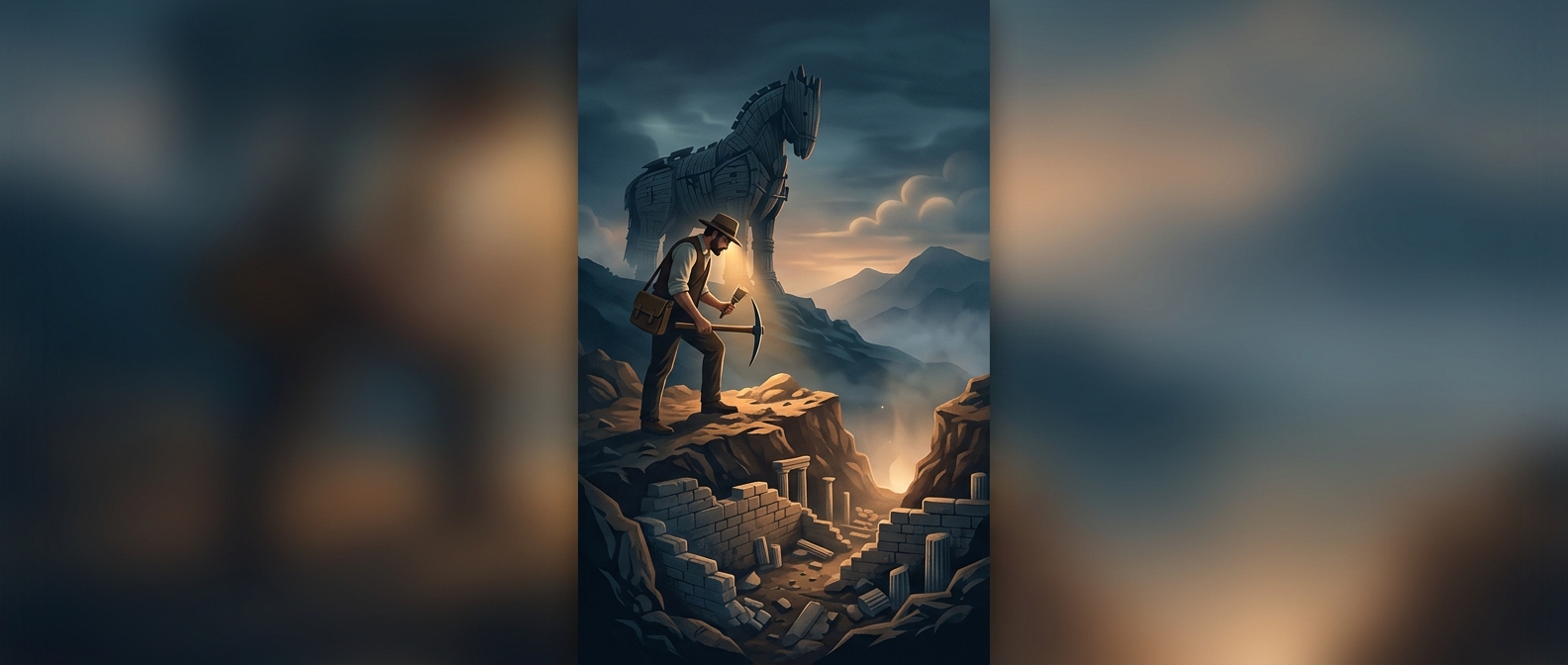
Heinrich Schliemann, a wealthy German businessman and self-taught excavator, believed the mound concealed the Troy described in Homer’s Iliad. To reach what he thought were the oldest and most important remains, he cut a broad, deep trench through the site. The trench exposed ancient structures, but it also sliced through later occupation layers on the way down.
In doing so, it removed not just soil but evidence: buildings and objects whose positions could have shown how the city changed over time. Once a layer has been dug away without careful recording, its original relationships cannot be fully recovered. The result can be a paradox: a dramatic excavation may reveal a past while making parts of that past harder to interpret.
Finding a city is not the same as reading it
Schliemann helped bring Hisarlik to wide attention as the site of ancient Troy. But he initially focused on an early layer he associated with Homer’s city; later archaeological work showed that Troy had many phases, and the identification of the Homeric city is more complicated than a single discovery.
His trench remains a vivid lesson in archaeological method: the path to a discovery can erase the context that tells us what the discovery means.