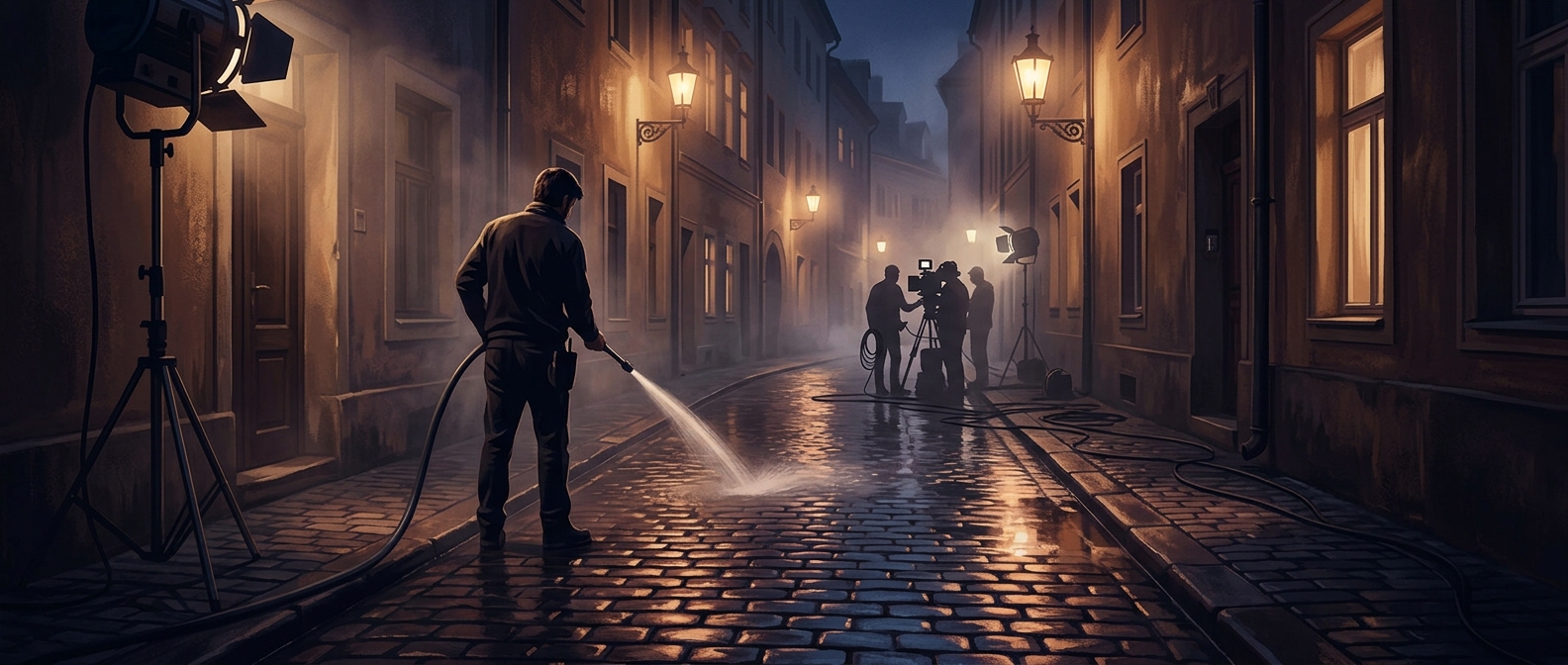
Water turns pavement into a lighting surface
A dry road scatters much of the light that hits its rough surface in many directions. Add a thin film of water and the surface becomes smoother, so it can return brighter, more defined highlights toward the camera. Streetlamps, shop windows, and production lights may then stretch across the ground as luminous streaks—visual detail a dry street would largely swallow.
Water also darkens pavement, increasing the contrast between the road and those highlights. That contrast helps a night scene feel layered: the street is still visible, but it seems to catch and carry light rather than sit flat in the frame. The effect depends on the camera angle and where the lights are placed; a wet patch reflects only what can reach it and bounce toward the lens.
A practical tool for shaping a shot
Wet-downs give crews a quick way to alter a location without rebuilding it. They can make ordinary asphalt or cobblestones read as freshly rained-on, and the amount and placement of water can be adjusted to suit the composition. A reflection that looks striking from the camera’s position may disappear when viewed from the sidewalk, because the camera sees a particular angle of reflected light.
The result is not simply “more shine.” It is a way to put light into the lower half of a frame, guide the eye along a street, and add depth to a night scene. The pavement becomes part of the lighting design—one reason a film street can look dramatically more luminous than the same street in everyday life.