How a count of twenty became a writing system
A base-20 system treats twenty—not ten—as the point where a count rolls over into a new place. The idea fits a body-based way of keeping track: after counting the fingers on both hands, a person could include the toes. In Mesoamerica, this way of grouping numbers became more than a counting aid; it shaped how numbers were written and used.
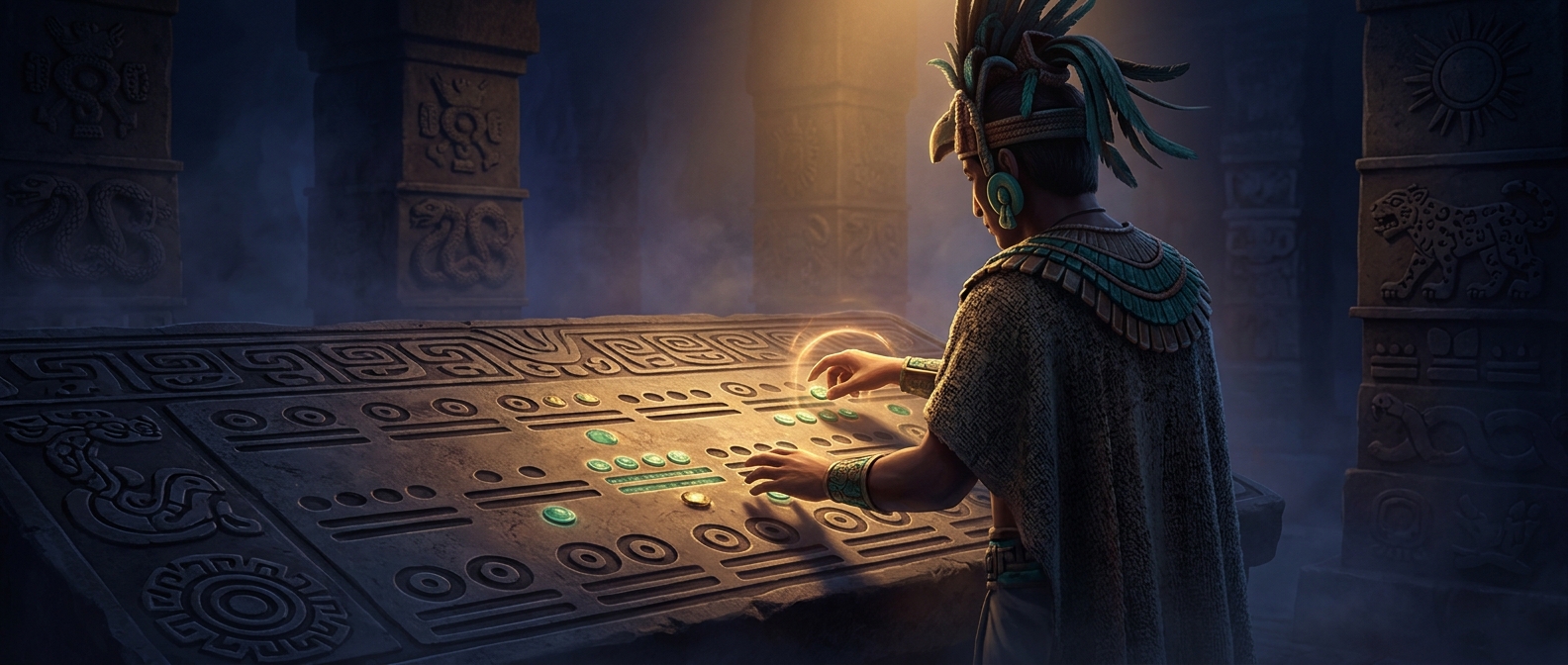
Maya numerals, one well-documented example, used dots for ones and bars for fives. A dot beside a bar, for instance, represented six. A shell-like sign served as zero, marking an empty place so that a number such as twenty could be distinguished from a mere one. This mattered because the system was positional: a symbol’s place changed its value, much as the places in 206 distinguish hundreds, tens, and ones.
The calendar made the system practical
Maya numbers were arranged vertically, with each higher position generally worth twenty times the one below. Calendar counting adapted that pattern to the solar year. Since 18 groups of 20 make 360, the calendar year used 18 named periods of 20 days, followed by five additional days. That adjustment kept the count near the length of a year without abandoning the familiar grouping by twenties.
The result was a system suited to recording large spans of time as well as everyday quantities. Its zero and place-value notation let scribes express numbers compactly and track dates across long cycles—turning a count suggested by the body into a tool for organizing history and ritual.