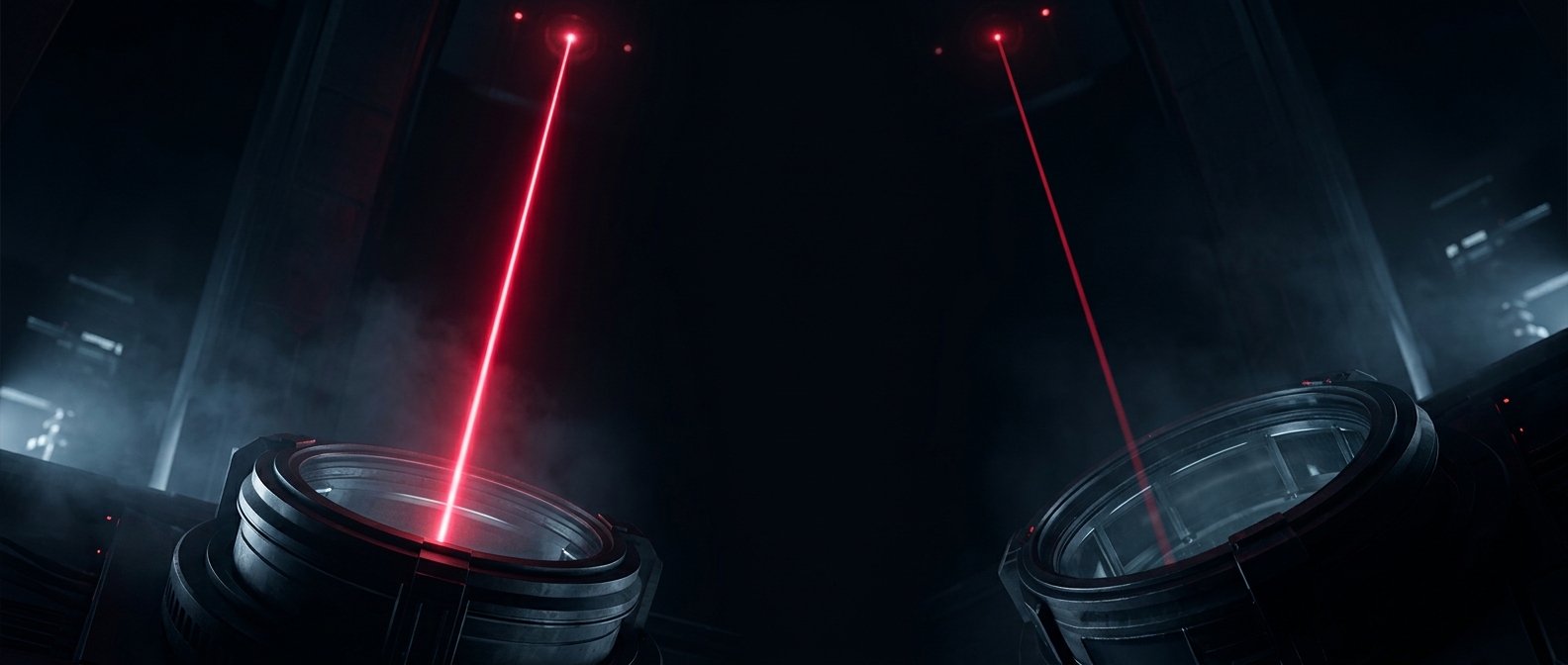
Light travels through space without announcing its path
A laser can cross a room without making a visible stripe through the air. The light is there, but your eyes usually detect light only when it enters them. Looking at the beam from the side does not put you in its path: the laser’s rays continue forward rather than turning toward you.
How particles make a beam visible
Air contains tiny particles—dust, droplets, or smoke—that can redirect some laser light. This redirection is called scattering. When scattered light reaches your eyes, you see a glowing track along the beam. Smoke makes that track especially clear because it adds many particles for the light to hit.
The same principle explains why a beam is hard to see in very clean air and why it becomes obvious in a smoky room. The beam itself has not switched on or off; what changes is how much of its light gets redirected toward an observer.
The spot is a different story
When the laser reaches a surface, the surface can reflect light in many directions. Some of that reflected light then reaches your eyes, making the endpoint visible even when the path through the air is not.
So a laser pointer’s familiar dot is not proof that the beam is visible from the side. It is light arriving from the surface where the beam ends; in particle-poor space, the route between you and that dot can remain unseen.