A journey designed to change the viewer’s position
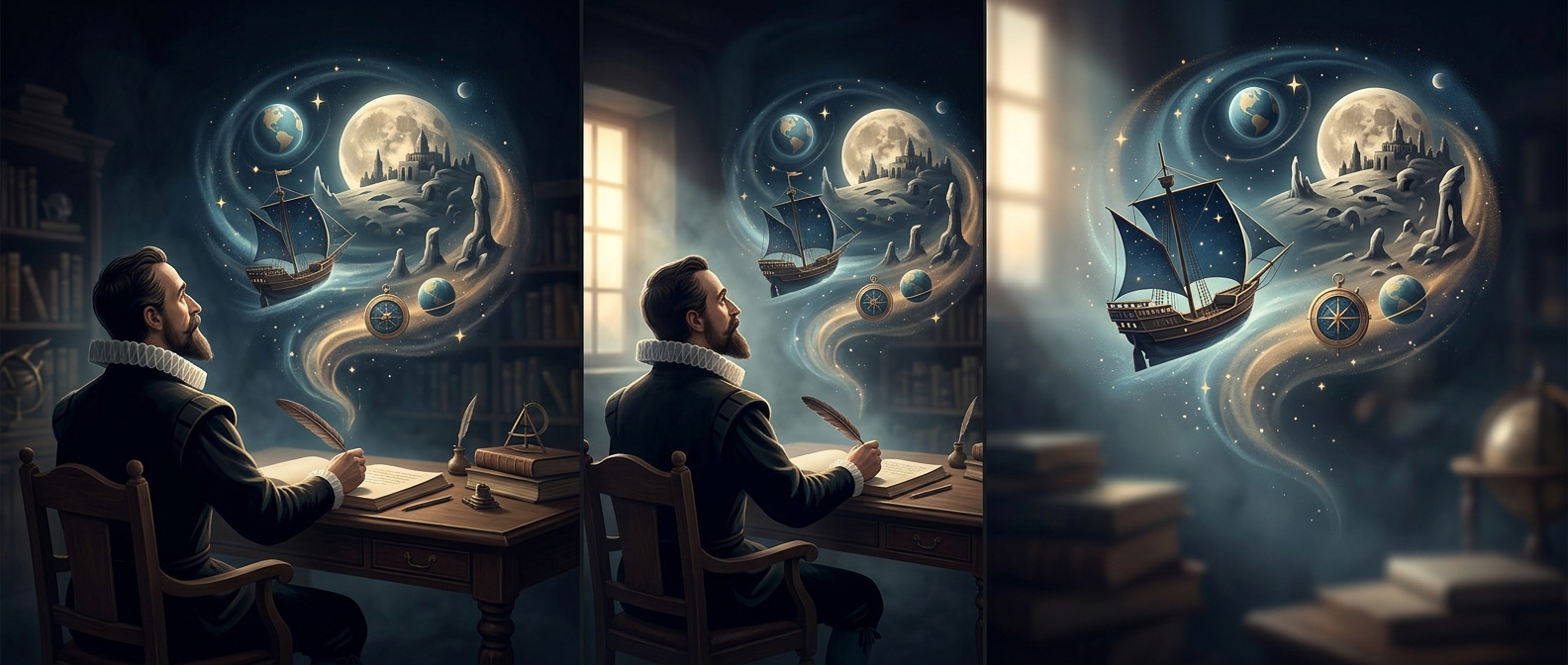
In Somnium—Latin for “The Dream”—Johannes Kepler sends a young man from Earth to the Moon, where the familiar sky looks radically different. The trip is more than a fantastic adventure: it gives readers a way to imagine what astronomy claims about a moving Earth. From the Moon, Earth would appear to shift across the sky, just as the Moon appears to move when observed from here. Changing the observer’s vantage point makes a difficult idea easier to picture.
Kepler wrote the tale in 1608, but it appeared in print only after his death, in 1634. He wrapped the astronomical thought experiment in a supernatural plot: the traveler’s mother has dealings with a spirit that can carry him moonward. That framing let Kepler turn an abstract argument into a narrative, while the fantastic machinery signaled that the journey was imagined rather than an account of a possible voyage.
The Moon is not a second Earth
Kepler also uses the story to make the destination strange. A lunar day lasts much longer than an Earth day, so the Moon’s surface would endure extended periods of sunlight and darkness. The tale imagines its inhabitants as creatures shaped by those harsh conditions, rather than people simply living under a different sky. The details invite readers to follow a practical question: if the environment changes, what kinds of life could endure there?
The story’s explanatory force comes from combining those perspectives. Readers first travel away from Earth, then have to reconsider the motions and conditions they normally take for granted. Kepler’s Moon is a fictional setting, but the shift in viewpoint is an astronomical tool: it turns the Earth itself into an object in the sky.