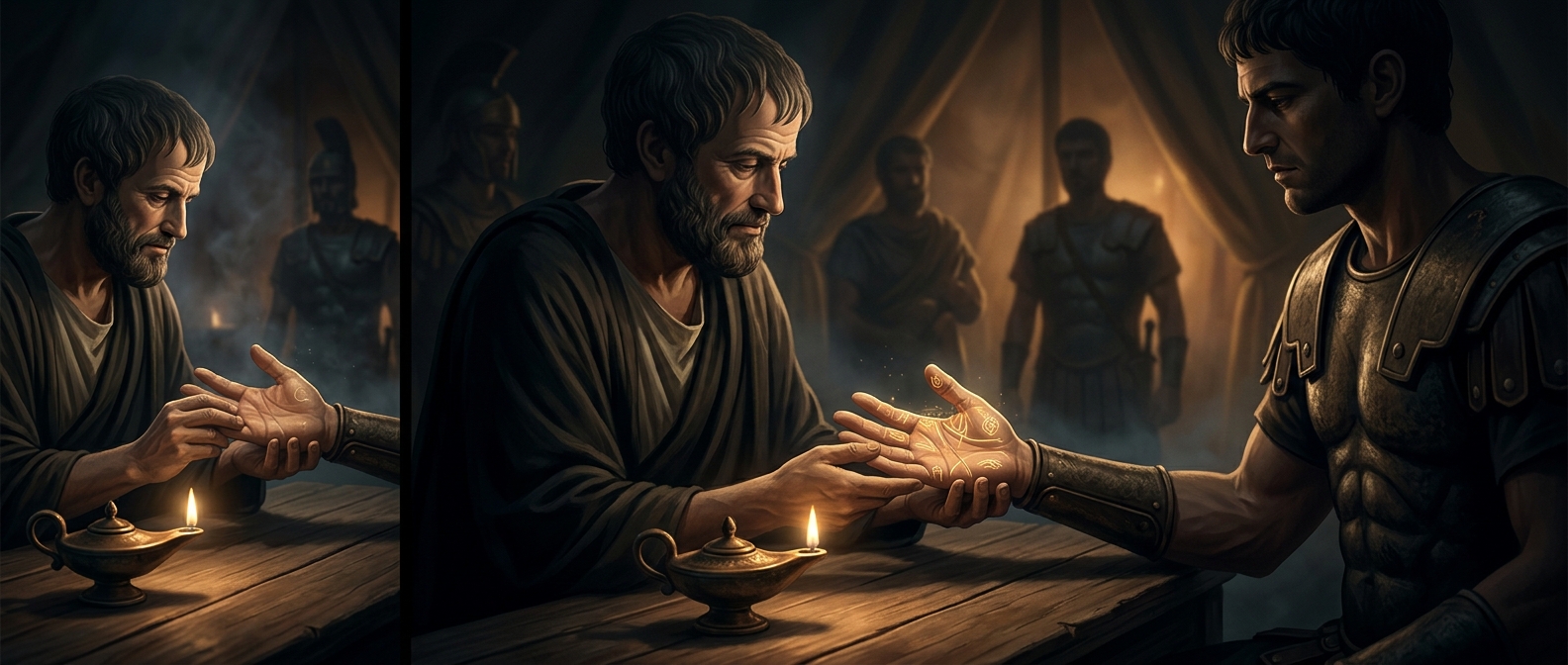
How palm reading acquired an Egyptian past
Palmistry—the practice of interpreting lines and shapes on a person’s hand—has roots in ancient India. Its later European identity, however, was shaped in part by Romani fortune-tellers who presented palm reading as ancient Egyptian wisdom. That framing gave the practice a distant, mysterious pedigree, even though the Indian origin and the Egyptian story are not the same claim.
A mistaken label became part of the story
Romani people, whose ancestors came from the Indian subcontinent, were often misidentified by Europeans as Egyptians. The English word “Gypsy” grew out of that mistaken belief. When Romani readers were described as Egyptian, the label could make their fortune-telling seem connected to an exotic ancient civilization rather than to a tradition with roots in India.
The story shows how a practice can travel with its explanation altered along the way. A palm reader’s identity, the name outsiders gave that person, and the supposed origin of the art could reinforce one another—until “Egyptian” sounded like a history rather than a claim.
What the label concealed
The European association did not establish that palmistry began in Egypt. It reflects how Romani people were categorized and how a claimed ancient origin could help make a form of fortune-telling compelling to clients. The familiar “Egyptian” image obscured the Indian roots of palm reading while preserving a false assumption about Romani origins.