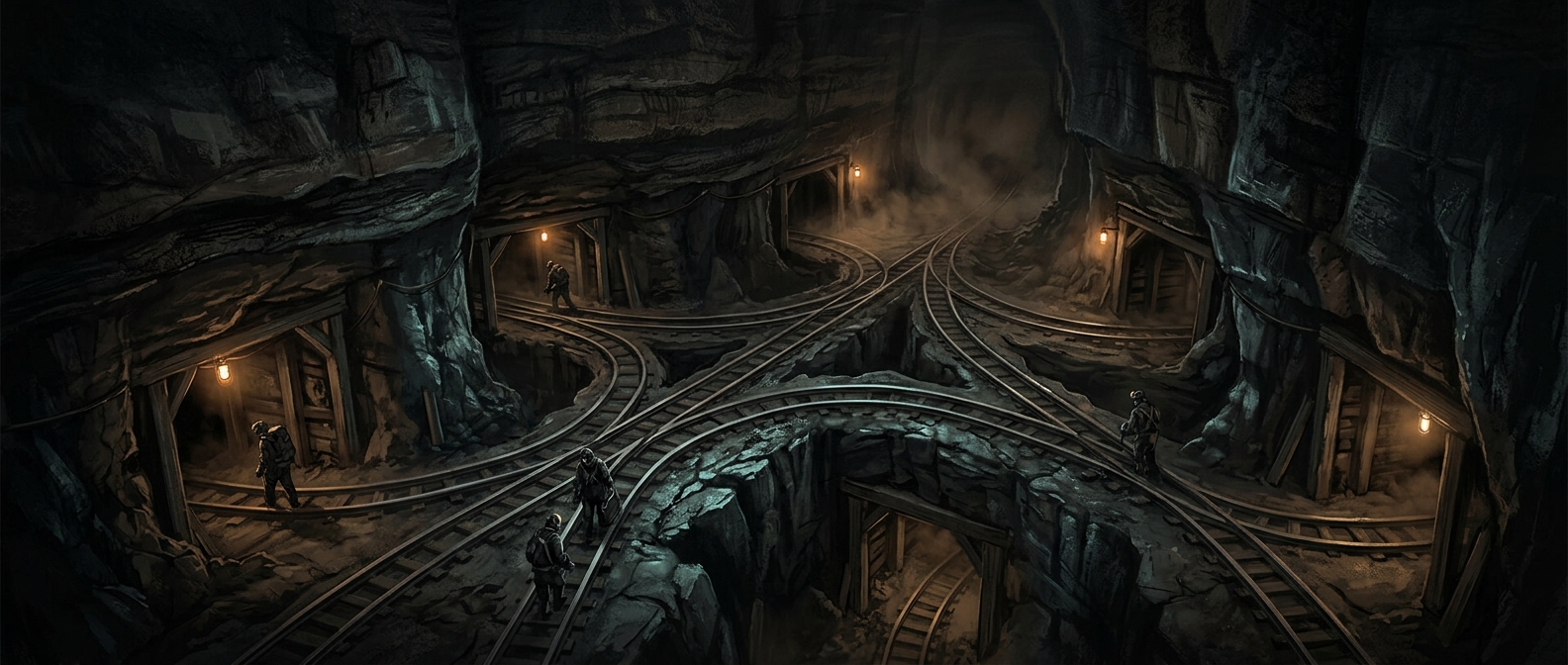
How coal dust turns a local blast into a chain reaction
Coal dust is not dangerous simply because it lies on the floor. The risk rises when fine particles become suspended in air, where they can burn rapidly. An initial explosion can stir settled dust into a cloud; if that cloud reaches a flame, the fire can spread beyond the point where it began.
The blast therefore has two ways to travel: its pressure wave pushes through the passages, while the moving flame ignites dust farther along. Each newly ignited stretch can create more heat and pressure, lifting additional dust and extending the chain reaction.
Why the tunnel network matters
Mine passages are built to connect work areas and carry people, coal, and ventilating air. Those connections make the mine function as a system—but they also leave openings through which pressure and flame can move. A tunnel that seems safely distant from the original blast may still be linked to it by a continuous route of dusty air and passageways.
The danger is not that every mine tunnel automatically amplifies an explosion. It depends on conditions such as how much combustible dust is present and whether it can be stirred into the air. But when those conditions align, the mine’s connected layout can let a fire spread far beyond its ignition point.
The hidden cost of efficient movement
The same passages that make underground work possible can transmit the consequences of a single ignition. That is why managing dust is not merely a housekeeping concern: deposits left along a route can become fuel for the next section of an explosion.