A toy that made lift visible
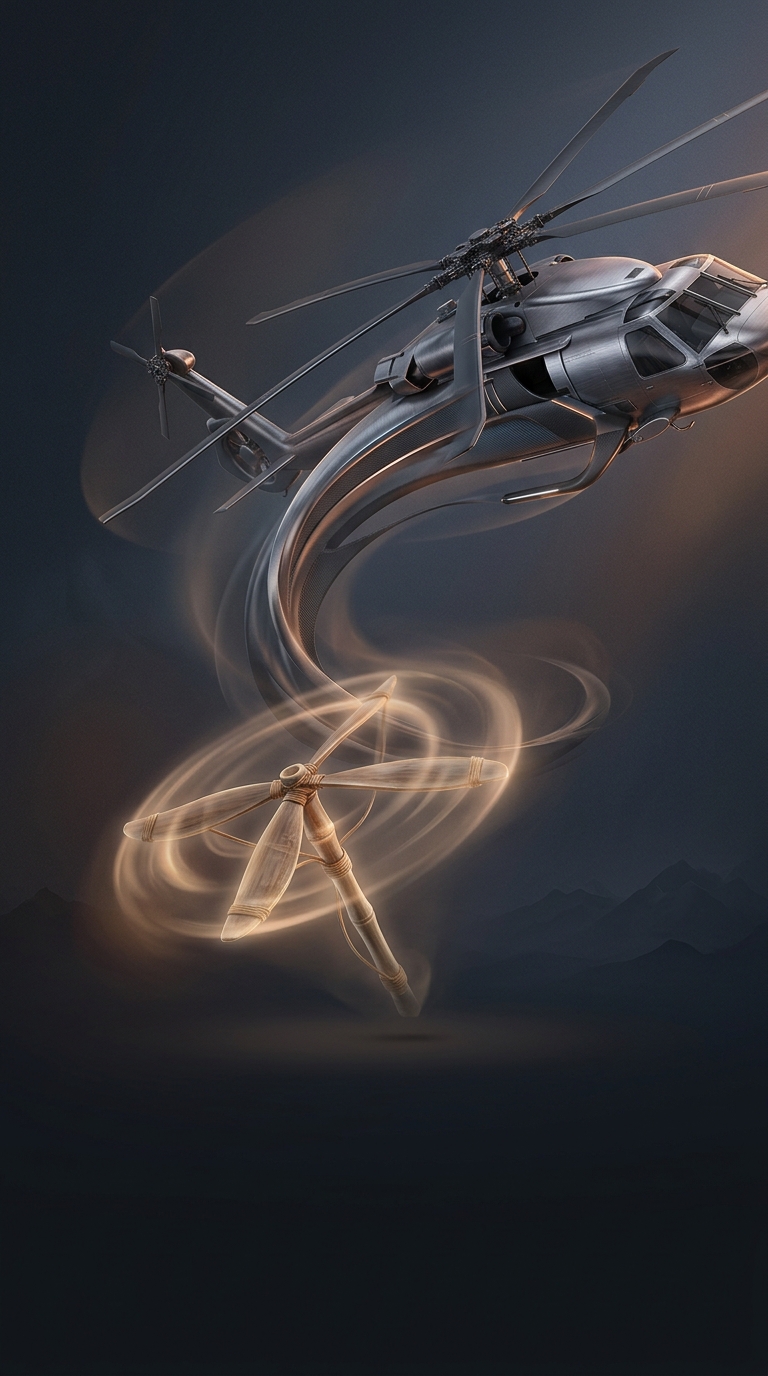
A bamboo flying toy is useful because it makes an invisible force easy to see. Its slanted rotor blades meet the air at an angle. As the spinning blades push air downward, the air exerts an upward force on the rotor. The toy rises briefly, then falls as the rotor loses speed. The basic exchange—air pushed down, aircraft lifted up—is still central to helicopter flight.
The toy does not, by itself, explain how to build a helicopter. Its quick hand-powered spin offers little control and lasts only a short time. George Cayley and other nineteenth-century experimenters treated small flying models as clues to a much larger engineering problem: how to keep a rotor turning, carry useful weight, and steer reliably.
What changes when the rotor grows
A helicopter’s engine supplies continuous power to its rotor, whose blades are shaped like rotating wings. The pilot can change how much lift the blades produce and how that lift is distributed around the rotor, allowing the aircraft to rise, descend, or tilt. A separate system must also counter the twist that the powered rotor would otherwise impart to the body; in a conventional helicopter, the tail rotor helps do that.
Those added systems mark the difference between demonstrating a principle and making a practical aircraft. A toy can float for a moment without carrying a person or choosing a direction. A helicopter has to maintain lift while balancing forces and responding to the pilot’s controls.
From demonstration to machine
The Chinese flying toy was not a miniature helicopter blueprint in the modern engineering sense. Its lasting importance is more basic: it offered an early, tangible demonstration that a spinning rotor could produce upward lift. The striking leap is not that a child’s toy contained all the answers, but that the same air-moving principle remains at work when a powered rotor lifts a heavy aircraft off the ground.