Why Early Wireless Carried Dots and Dashes
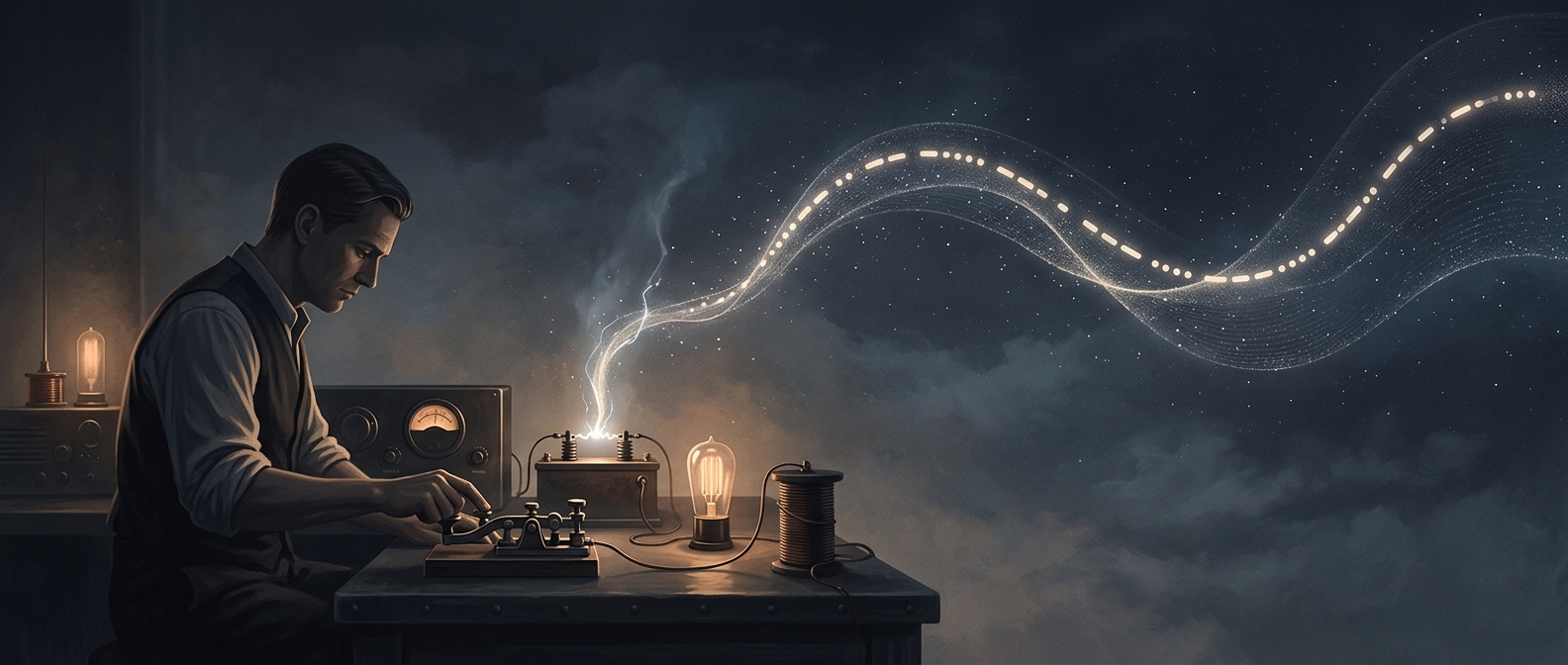
A radio message began with an operator pressing a telegraph key. Each press switched the transmitter on, sending a burst of electromagnetic energy; each release stopped it. Short and long bursts formed the dots and dashes of Morse code. At the receiving station, equipment turned those bursts into clicks or other signals an operator could interpret.
This on-off method fit the hardware. Early transmitters could make detectable bursts, but they could not smoothly vary a radio wave in step with a speaker’s voice. Speech is a continuously changing sound, with many pitches and quick shifts. Sending it meant preserving those changes through the transmitter and receiver—something the first wireless systems were not built to do.
A Telegraph Network Without the Wires
Morse code made wireless useful before voice transmission was practical. Operators could send messages across distances without laying a cable between stations, but the system still depended on trained people at both ends: one to tap out the code, another to listen and write it down. The radio link removed the physical wire, not the human work of telegraphy.
That limitation shaped what early radio meant. It was not yet people speaking directly to a distant audience; it was a new way to carry the familiar language of telegraph signals through the air. The first step toward radio communication was therefore not a voice on the air, but a sequence of precisely timed silences and bursts.