How a drip becomes stone
Rainwater picks up carbon dioxide as it moves through soil, becoming slightly acidic. On its way through limestone, it dissolves a small amount of the rock’s calcium carbonate. When that mineral-rich water reaches a cave ceiling, some carbon dioxide escapes into the cave air, and a little water evaporates. The change makes the water less able to hold the dissolved mineral, so calcite—the crystalline form of calcium carbonate—settles out.
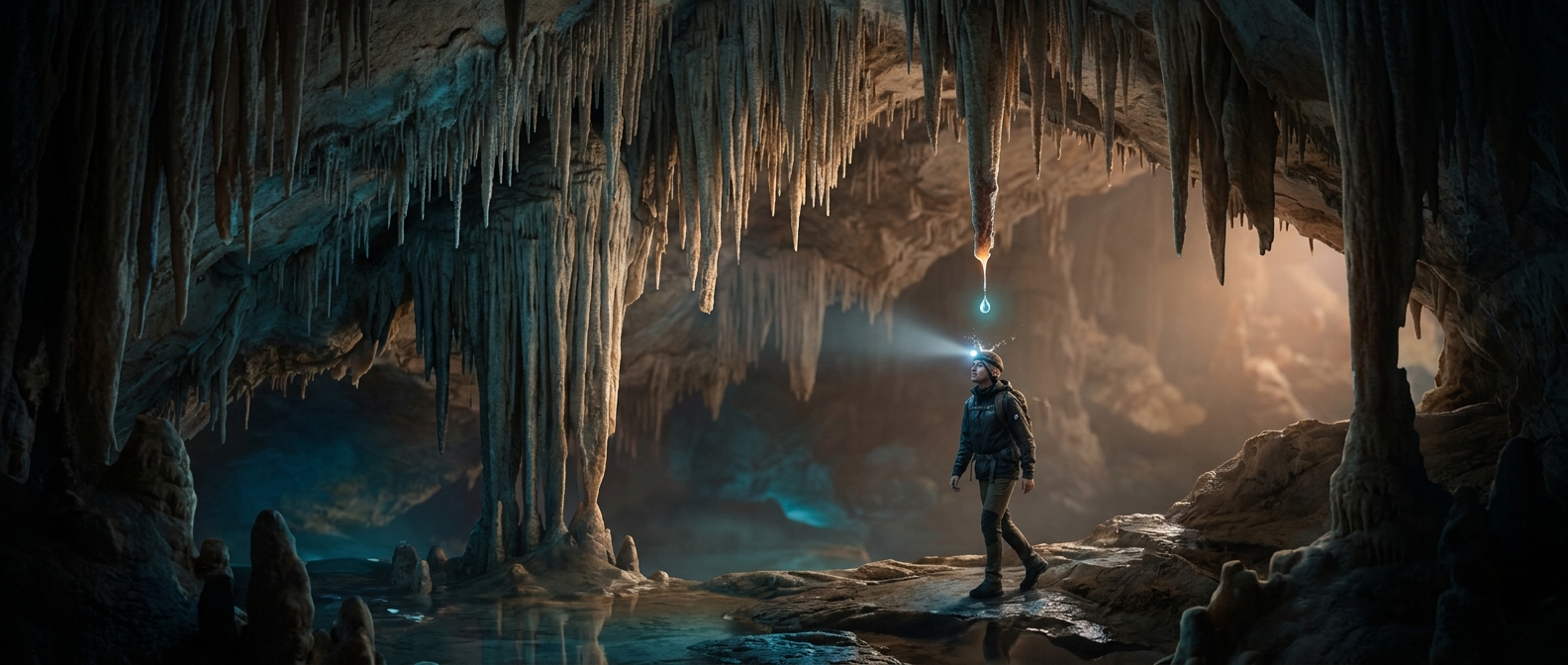
A drop may leave only a thin rim of calcite behind. Repeated drops gradually build that rim into a hanging tube and, eventually, a thicker cone called a stalactite. Drops that land on the floor can build upward-growing stalagmites.
Why the growth is so slow
Each deposit is tiny, and the next one depends on another drop arriving with the right mix of dissolved mineral. The pace varies with the water supply, the amount of carbon dioxide, and cave conditions such as temperature and airflow. A change in any of these can speed growth, slow it, or shift where mineral is deposited.
That makes a stalactite less like a rock being carved out all at once and more like a record assembled one small layer at a time. In a quiet cave, the visible result may take many generations of drips—and the dinner joke gets its geological scale from that patient accumulation.