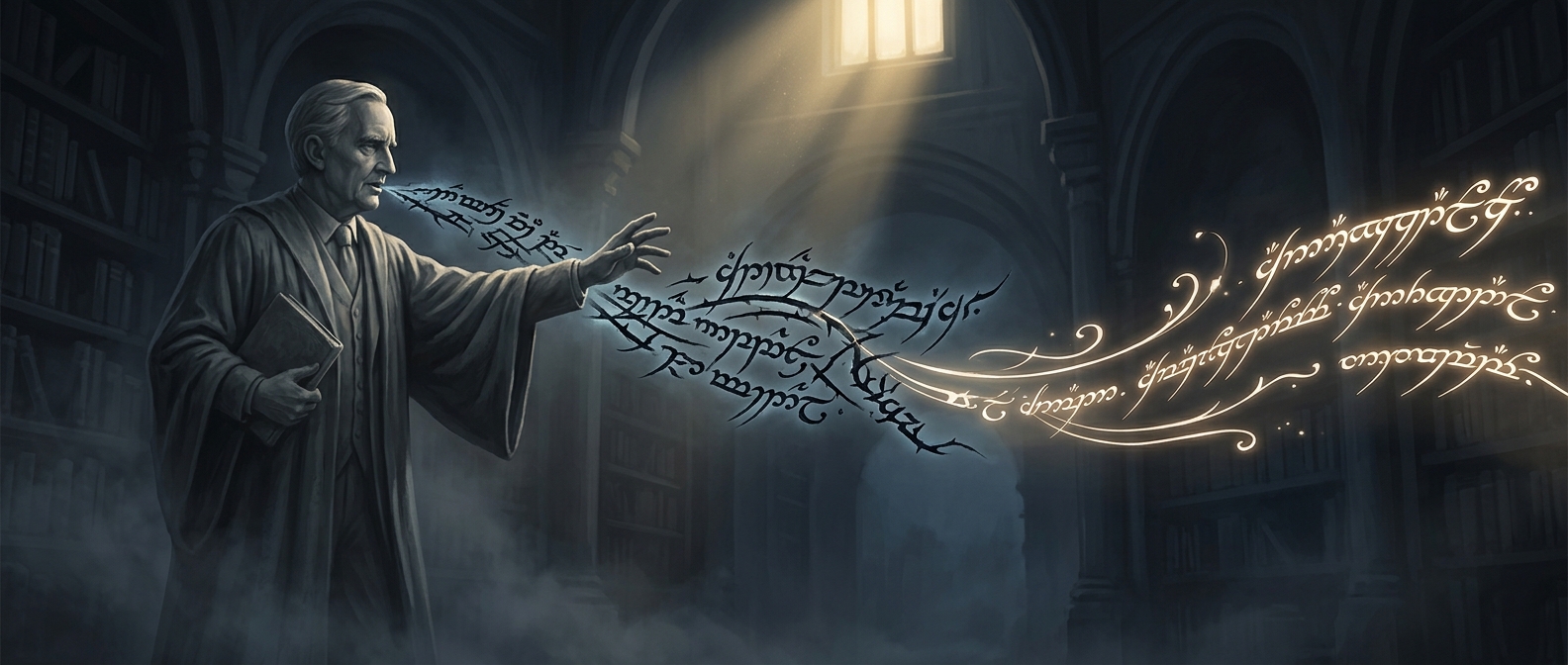
Tolkien’s tastes shaped his invented languages
Tolkien’s dislike of French was part of a personal taste, not a rule that every language in Middle-earth had to exclude French or Latin. The deeper connection was his lifelong fascination with how languages sound and change. He built languages for the pleasure of imagining their histories, then developed peoples, places, and stories around them.
That made linguistic preference a creative starting point. Tolkien found certain sounds and structures especially appealing: Quenya, the language associated with the High Elves, drew strongly on Finnish, while Sindarin was shaped largely by Welsh. Those influences gave the languages distinct textures and helped make them feel as though they belonged to different histories and communities.
Influence was a palette, not a ban
Tolkien was a professional philologist—a scholar of language and its history—and knew Latin and the Romance languages. His dislike of French therefore did not mean he rejected Latin-based language as a subject or could somehow keep every classical influence out of his work. Rather, he chose models that suited the sound and imagined ancestry he wanted for particular languages.
The distinction matters: his invented tongues were not assembled by mechanically removing French or Latin elements. They were designed through selective inspiration, with sound, grammar, and fictional history reinforcing one another. A personal aversion could steer his choices, but the lasting result was not a linguistic blacklist; it was a world in which different peoples could be heard as having different pasts.