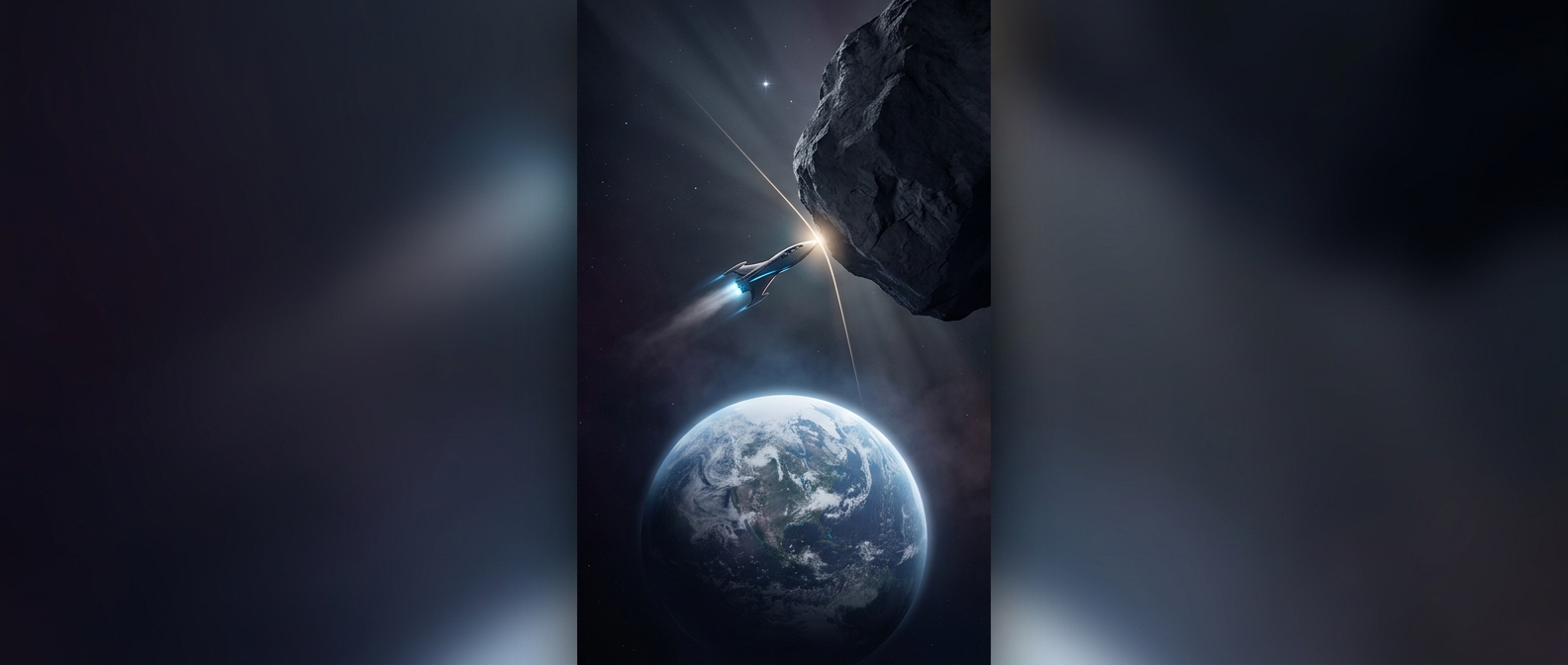
Why a tiny speed change can become a big miss
An asteroid does not need to be stopped to avoid a collision. It only needs to reach Earth’s orbital path at a different time or place. A spacecraft’s impact can change the asteroid’s velocity—the speed and direction of its motion—by a small amount. That difference may seem negligible at first, but it changes where the asteroid will be after each trip around the Sun.
The orbit turns a nudge into distance
Think of the asteroid as arriving at a crossing point in space. Before the impact, its orbit brings it to that point at a particular time. A small speed change shifts the timing, so Earth and asteroid may no longer arrive at the crossing together. The longer the warning, the more time the altered orbit has to carry the asteroid away from the dangerous encounter. The goal is a miss measured in space, not a dramatic shove.
That is why early detection matters as much as the impact itself. A last-minute collision would have little time to accumulate a useful change in position. With years of warning, even a modest nudge could produce a much larger separation by the time the asteroid reaches Earth’s orbit.
What DART tested
NASA’s Double Asteroid Redirection Test, or DART, deliberately crashed a spacecraft into Dimorphos, a small moonlet orbiting the asteroid Didymos. Dimorphos was chosen as a safe test target, not because it posed a threat to Earth. Because the moonlet’s orbit around Didymos could be observed, scientists could measure whether the collision changed its motion.
The test demonstrated the central idea: a spacecraft impact can alter an asteroid’s path. A real response to a threatening object would still depend on finding it early and understanding its orbit well enough to choose a suitable intervention. The practical payoff of spotting an asteroid years ahead could be that a small course correction prevents a close encounter from becoming a collision.