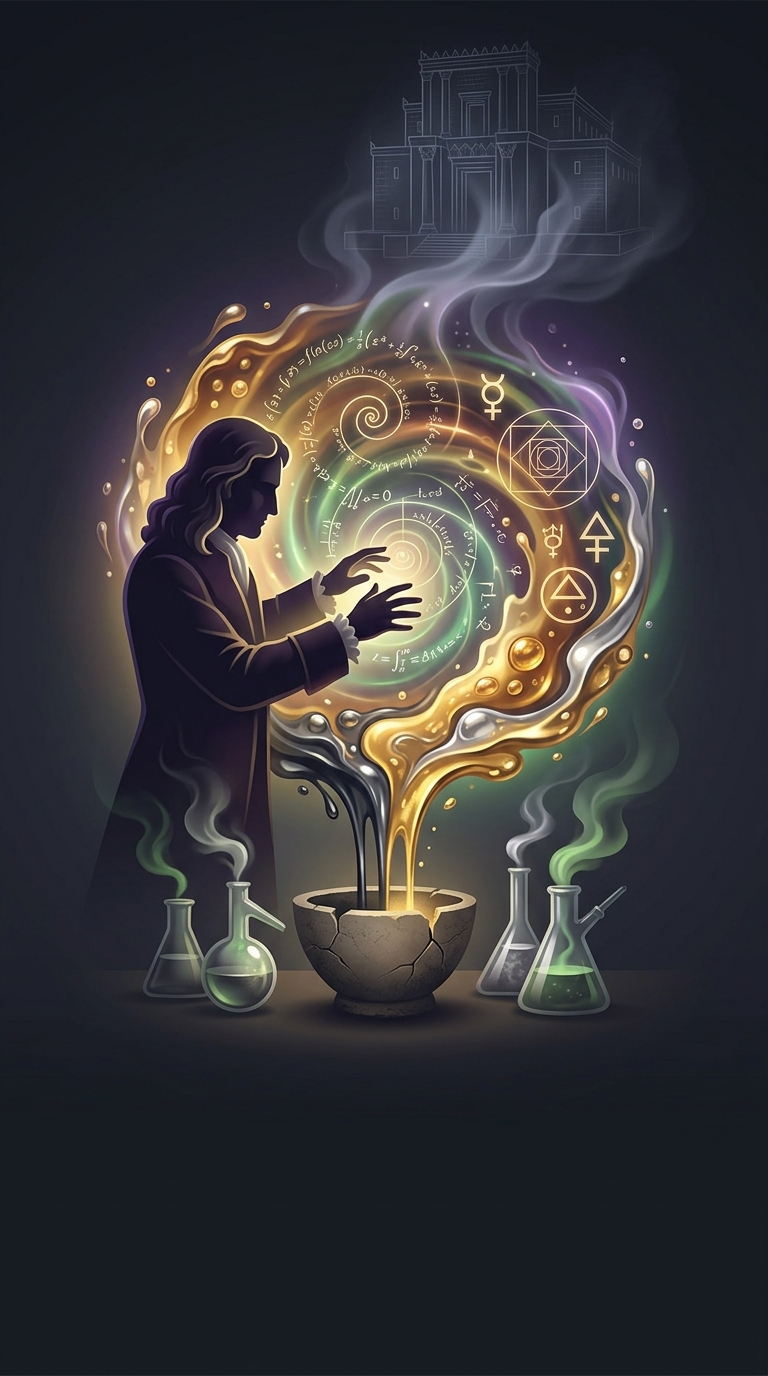
Why alchemy mattered to Newton
For Newton, alchemy was not a side hobby neatly separated from his science. It offered a way to investigate what matter was made of and how it might change. Alchemists sought the Philosopher’s Stone, a substance they believed could transform ordinary metals into gold; some also associated it with medicinal powers. The stone was a goal, not a proven discovery, but pursuing it meant studying metals, heat, mixtures, and transformations.
A laboratory practice wrapped in secrecy
Alchemy combined hands-on experiments with inherited theories and symbolic language. Practitioners heated materials, distilled liquids, and watched substances change color or form. They recorded procedures in cryptic notes, a tradition that made their work difficult to interpret—and helps explain why Newton’s alchemical writings can look very different from his mathematical and physical work.
Those experiments also involved hazardous substances. Mercury can release poisonous vapor, especially when heated. Newton’s hair analysis indicates substantial mercury exposure, although that finding alone cannot establish exactly when or how he encountered it, or what effects it had on him.
The cost of pursuing transformation
Alchemy belonged to a period when the boundaries between chemistry, medicine, and mystical theories of nature were not drawn as they are today. Newton’s efforts therefore reveal more than an unusual personal interest: they show how a major investigator could use practical experiments to pursue a theory of matter that modern science would not accept. His search also carried a physical risk—the materials he hoped to transform could expose him to toxins in the process.