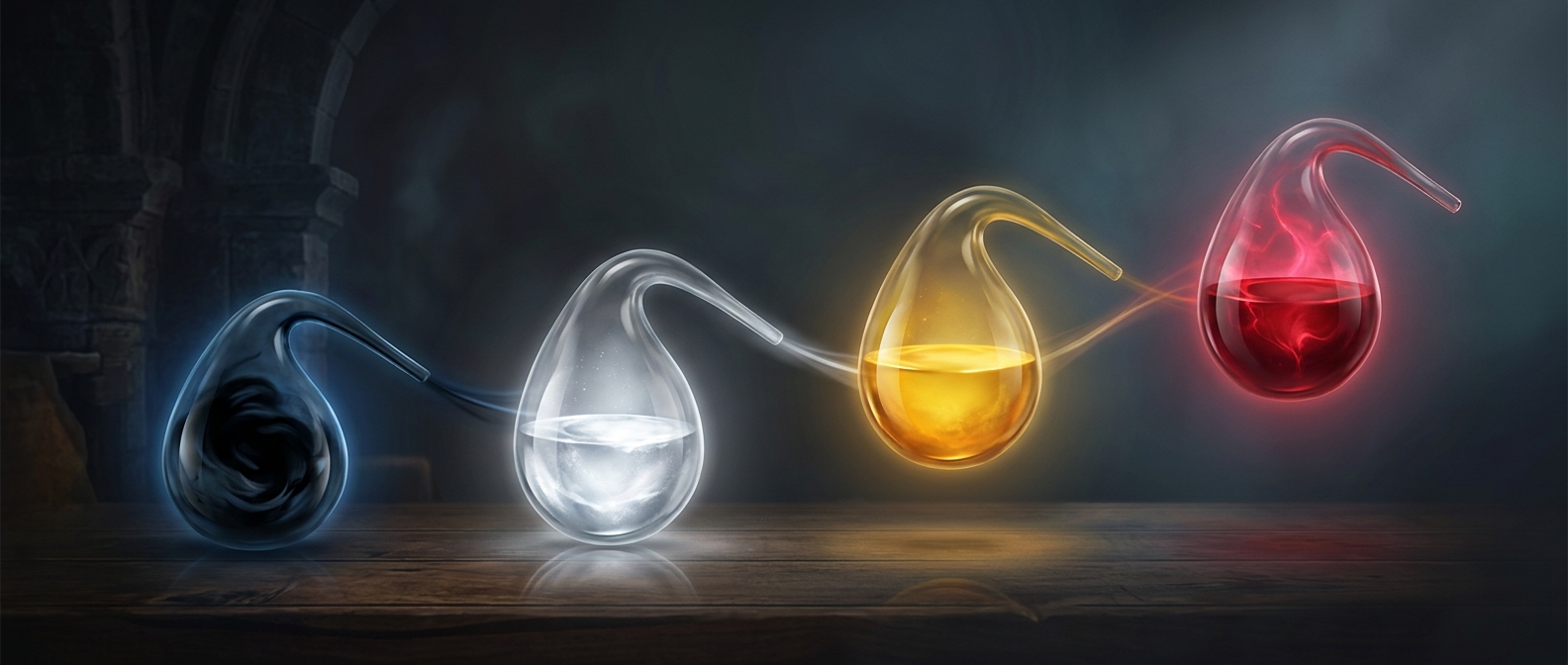
Why the Vessel Had to Stay Sealed
In alchemical accounts of artificial life, a glass vessel was more than a container: it was part of the imagined process. If a “spirit” could give matter its living quality, then heat might awaken it—but also make it flee. Sealing the glass was meant to keep that volatile essence from escaping while the material inside changed.
Here, “spirit” did not always mean a person’s soul in the modern religious sense. Alchemists used the word for an elusive, active principle associated with life and transformation, as well as for substances that seemed to vanish into vapor when heated. The overlap made it possible to picture evaporation as the loss of something vital.
A Closed World for Making Life
The vessel made the hoped-for creation seem containable and observable. Its walls separated the experiment from the outside world, while its seal promised that nothing essential would leak away. Heating could then be imagined as a controlled transformation: the contents might develop toward life without their animating spirit escaping into the air.
That logic belonged to a broader effort to understand whether living forms could be produced through art and natural processes. It was not a modern account of biology. Rather, it joined material change to a spiritual vocabulary in which preserving an invisible principle mattered as much as preserving the visible ingredients.
The striking idea is that, in this picture of artificial life, the glass did not merely hold the experiment together. Its seal was imagined as keeping life itself from evaporating.