Why St. Basil’s Domes Don’t Match
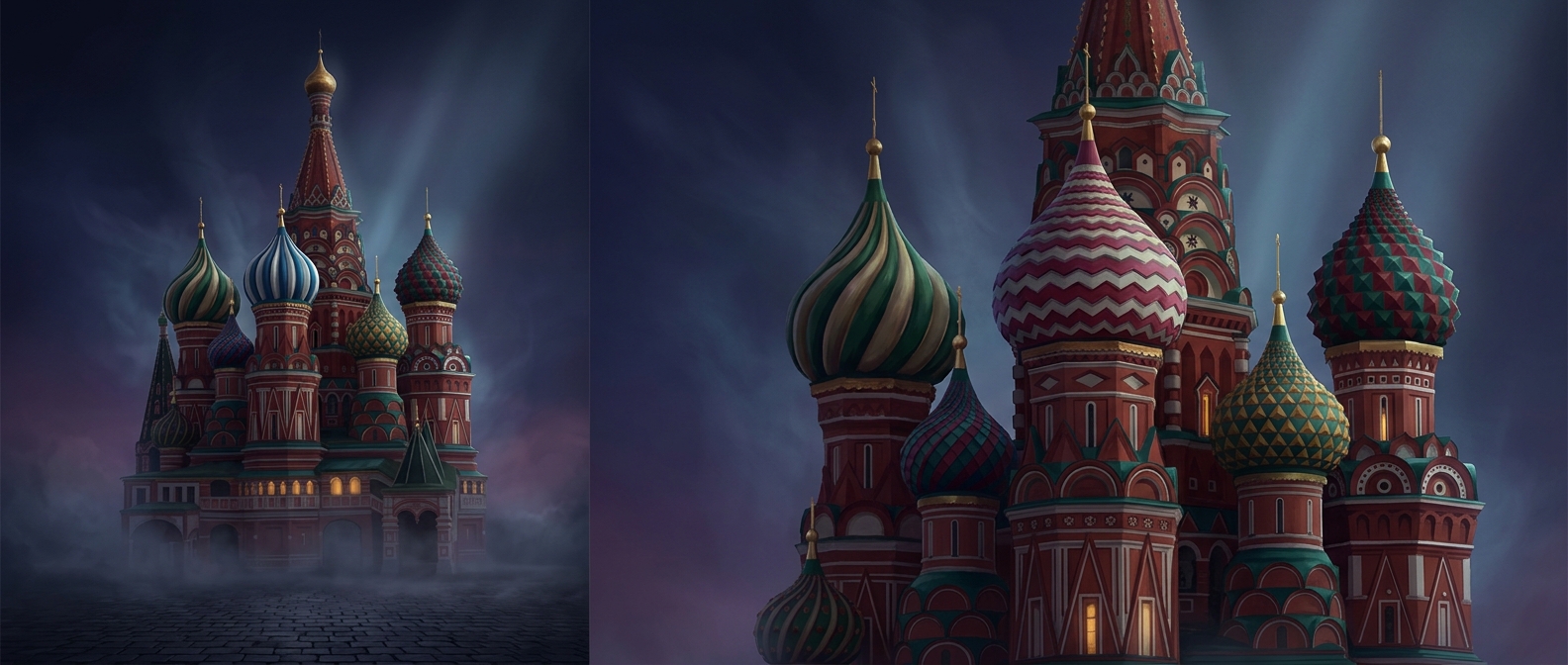
St. Basil’s Cathedral in Moscow is not a single, symmetrical building crowned with interchangeable domes. It is a cluster of chapels grouped around a central church, each with its own interior and roof. Their domes rise at different heights and carry distinct patterns, making the skyline look more like a gathered collection than a carefully repeated design.
A Building That Grew in Stages
The cathedral was built in the 16th century under Ivan IV, commonly known as Ivan the Terrible, to mark the capture of Kazan. Its central church and surrounding chapels formed a complex plan rather than a conventional long hall. That layout helps explain why the exterior is varied: the domes belong to different parts of the structure, not to a uniform row of matching towers.
The bright, elaborate appearance familiar today also reflects changes over time. The cathedral’s surfaces and decoration were altered and renewed after its original construction, so its present colors and swirling patterns should not be mistaken for a perfectly preserved snapshot of one moment in the 1500s.
Variety Made Visible
From outside, the mismatched domes make the building’s underlying arrangement legible: separate spaces gather around a shared center, each marked by its own roof. Rather than resolving into a regular silhouette, the structure keeps its parts visually distinct—one reason its skyline is so immediately recognizable.