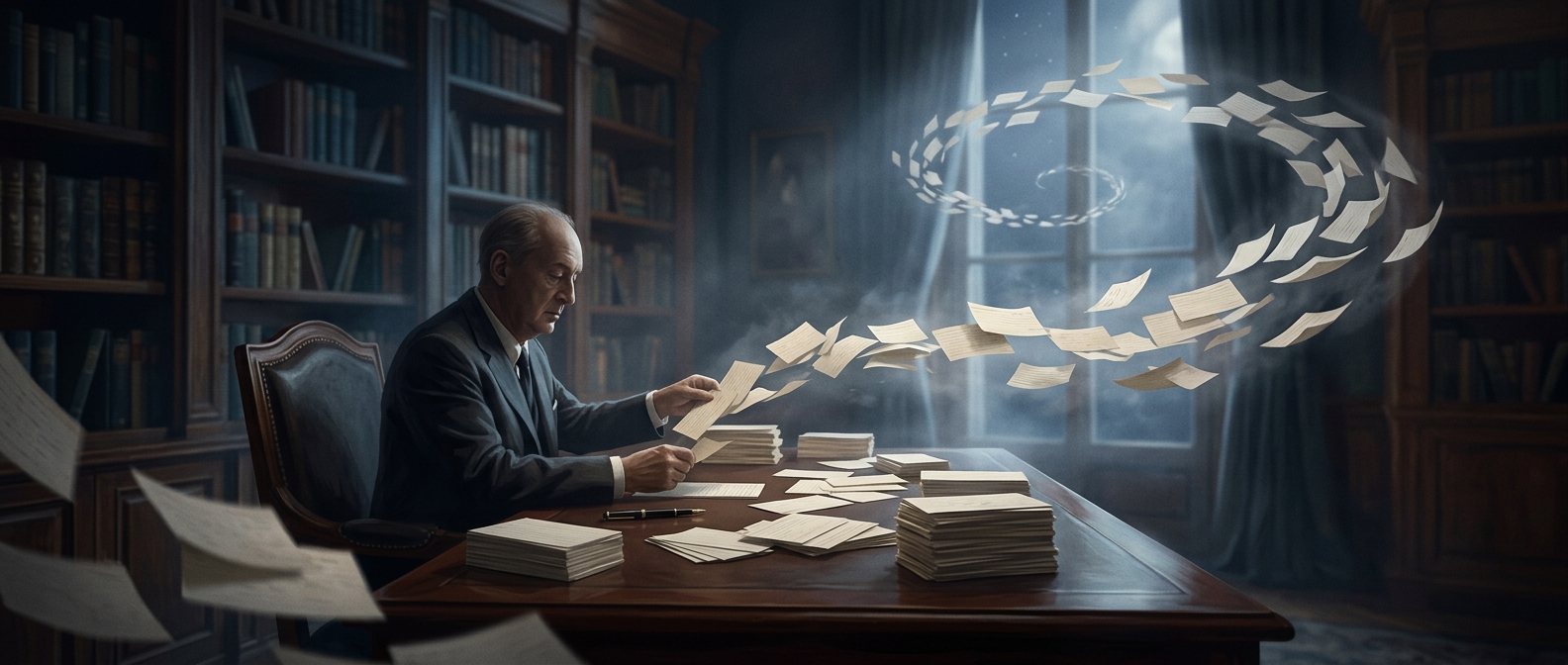
A novel built in movable pieces
Vladimir Nabokov drafted Lolita on index cards, keeping them in a long box. Each card let him work on a passage as a separate unit rather than committing immediately to a continuous manuscript. He could move cards around, testing how one scene changed the effect of another without rewriting the whole book each time.
That mattered because a novel’s order is part of its meaning. A scene placed early can create suspense; the same scene placed later can revise what the reader thought they understood. Cards made that order something Nabokov could handle physically: draft a passage, set it aside, then bring it forward or back as the larger design took shape.
Rearranging the story, not just the pages
The method suited a story told by Humbert Humbert, who recounts events retrospectively. Readers encounter his account through his own selective, self-serving narration, not as a simple record delivered in chronological order. Shuffling passages gave Nabokov a practical way to experiment with when information appeared and how the sequence shaped the reader’s response.
The cards did not make the novel random or remove the need for revision. They made revision more flexible. Instead of treating the first draft’s sequence as fixed, Nabokov could compare different arrangements until the progression of scenes served the book he was building. The long box was, in effect, a working model of the novel: its structure remained open to rearrangement until the pieces fell into place.