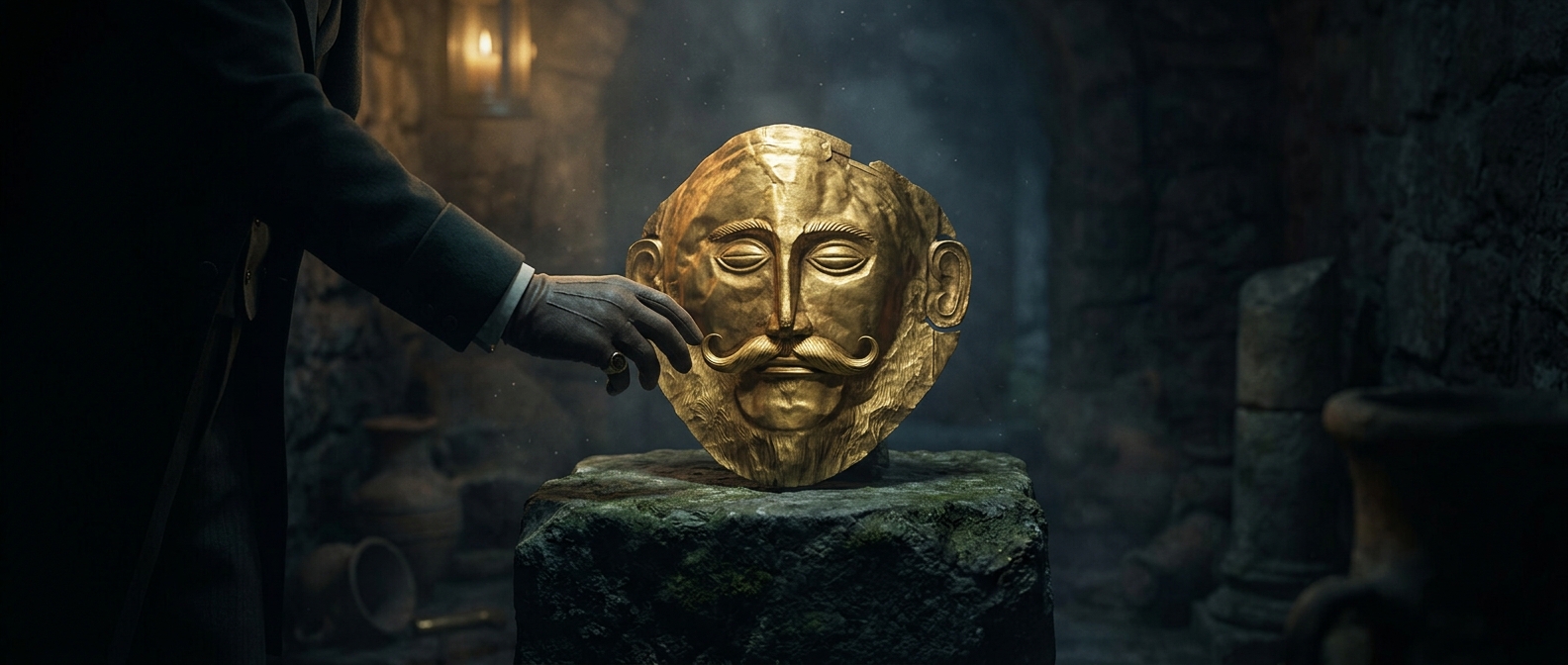
A Mustache That May Have Been Made for the Camera
When Heinrich Schliemann uncovered a gold funerary mask at Mycenae in 1876, he quickly connected it to Agamemnon, the legendary king in Homer’s Iliad. His famous declaration that he had looked upon Agamemnon’s face turned an archaeological find into a dramatic encounter with epic history. But the mask itself does not identify its wearer.
The detail now under suspicion is its prominent mustache. Some modern scholars think Schliemann may have had a goldsmith add or alter it, giving the face the bold, unmistakably masculine look that 19th-century viewers associated with a heroic ruler. That remains a suspicion, not a proven act: the mask’s appearance alone cannot establish who changed it, or when.
Why a Small Alteration Would Matter
A funerary mask is not a portrait in the modern sense. It was made to cover a dead person’s face, and its features may reflect artistic convention rather than a precise likeness. If the mustache was altered, it would complicate the mask’s use as evidence—not just about the dead person’s appearance, but about how Mycenaean artists represented people.
It would also reveal how interpretation can shape an artifact’s public meaning. Schliemann was searching for the world of Homer, and a commanding, mustached face could make that connection feel visible. Yet the mask came from a burial, not from an inscription naming Agamemnon. The famous identification tells us more about Schliemann’s reading of the find than it proves about the person beneath it.
That is why the mustache matters: a detail that looks like ancient evidence may also carry the tastes of the archaeologist’s own age.