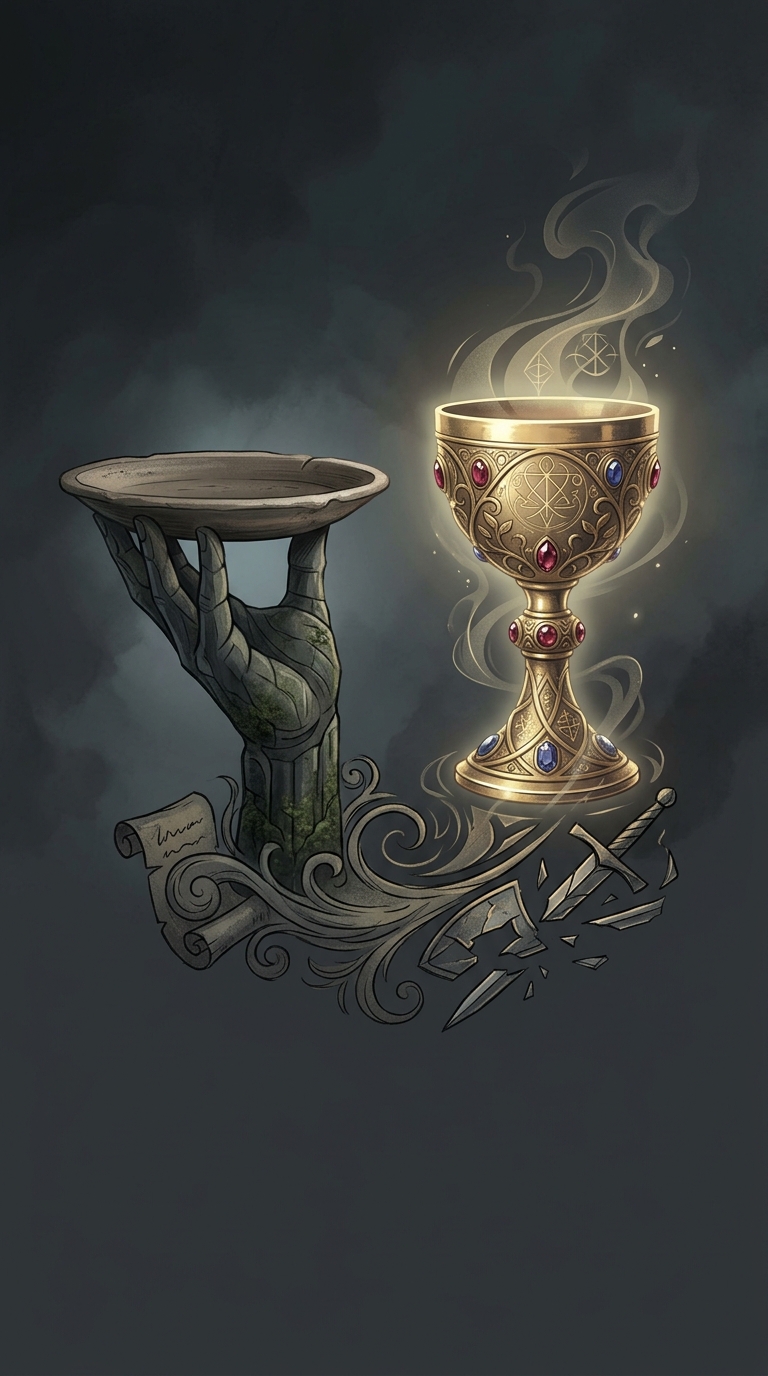
A mysterious dish enters Arthur’s world
The Grail’s literary trail begins not with a clearly identified holy relic but with a puzzling scene in Chrétien de Troyes’s late-twelfth-century romance Perceval. A young knight sees a richly adorned vessel carried through a hall during a feast. Chrétien calls it a graal, a word that could mean a serving dish or platter, and describes its brilliance—but never explains exactly what it is.
That uncertainty was part of the story’s power. The vessel appears alongside a wounded king and a strange procession, and the knight’s failure to ask questions becomes consequential. Chrétien died before completing the poem, leaving later writers room to supply answers.
From courtly mystery to Christian relic
In the generations that followed, authors gave the object a Christian history. In versions associated with the poet Robert de Boron, it became the vessel used at the Last Supper and later connected with Joseph of Arimathea, who collected Jesus’s blood. Other medieval writers reshaped the Grail differently, so there was never just one settled account.
The promise of immortality belongs to some later Grail traditions, not to every version. More broadly, the vessel came to represent a sacred object that could grant extraordinary favor—but only to a worthy seeker. Each retelling turned an unexplained prop in a romance into a test of spiritual character.
A medieval story becomes modern occult lore
Centuries later, the Grail’s aura of hidden power made it attractive to modern esoteric movements, which treated medieval legends as clues to secret history. Nazi leaders and affiliated occult enthusiasts also drew on such myths. Popular accounts say Heinrich Himmler searched for the Grail, but the story’s modern retellings often go beyond what can be firmly established about his intentions.
The lasting transformation is clear: a vessel whose meaning Chrétien left open became, through successive authors, a relic tied to Christ, miraculous power, and the hope of eternal life.