Why a game board takes more material than it seems
A folding board has to stay flat, hold its shape, and survive repeated opening and closing. Printers achieve that stiffness by laminating printed paper onto a thick, compressed paperboard core, often called chipboard. The core is what gives a board its weight and makes it feel solid in a player’s hands.
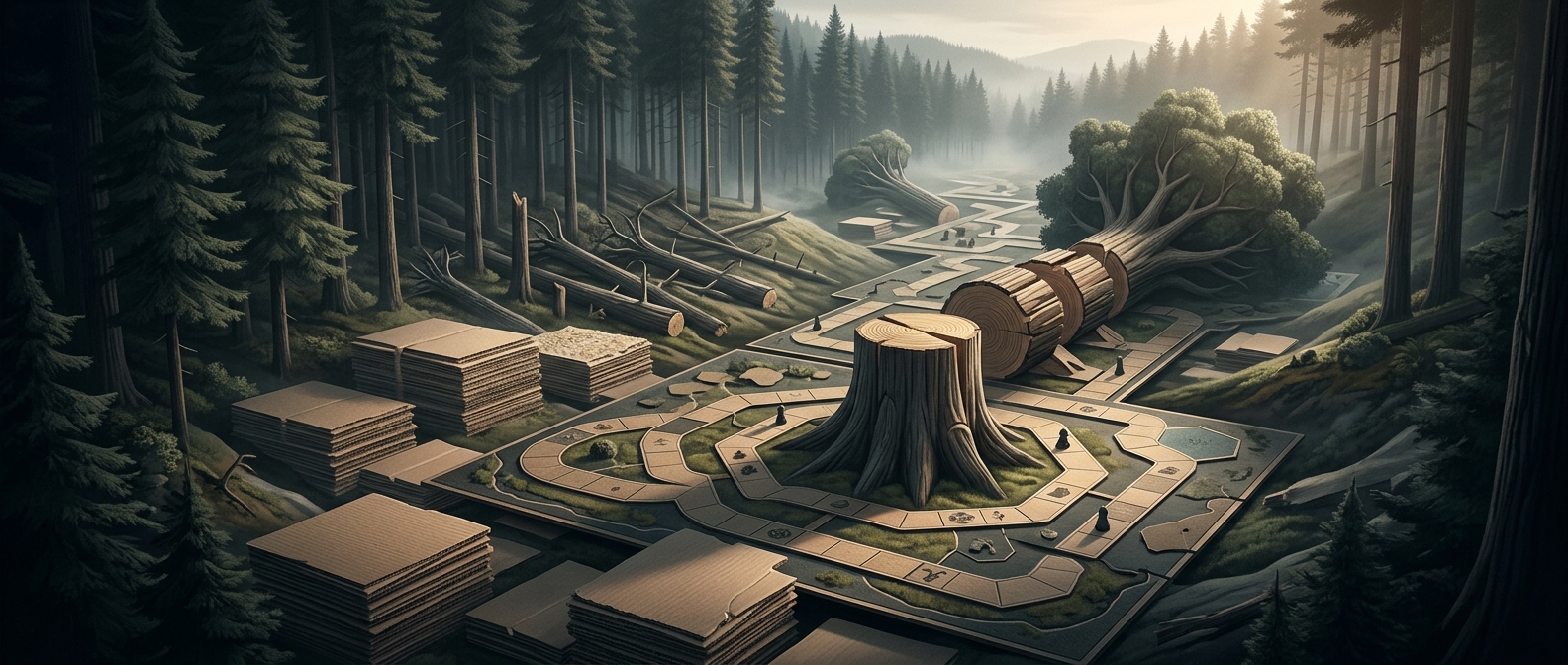
That thickness adds up across a production run. Each board uses a broad, nearly solid sheet, and the same material goes into other components such as punch-out tokens and box inserts. When the paperboard is made from virgin wood pulp—fiber processed directly from harvested trees—making enough for a large run can mean substantial demand for forest resources.
The material choice is built into the design
Recycled fiber can replace some or all virgin pulp, but the choice depends on the board’s required stiffness, thickness, finish, and ability to withstand handling. Paper fibers become shorter and weaker as they are recycled repeatedly, so manufacturers may blend in fresh fiber to meet performance needs. Coatings and laminated layers can also make a finished board harder to recycle than plain paper.
These choices matter because a board game is designed to be kept and replayed: its components need to endure years of use, not just look crisp on opening day. The environmental cost is therefore not simply a matter of making the board thinner. It lies in balancing durability with the source of its fibers and how easily the assembled parts can be recovered at the end of their life.
A sturdy miniature world begins as a surprisingly large sheet of material—and the fiber in that sheet determines whether forests supply the game directly or recycled paper does.