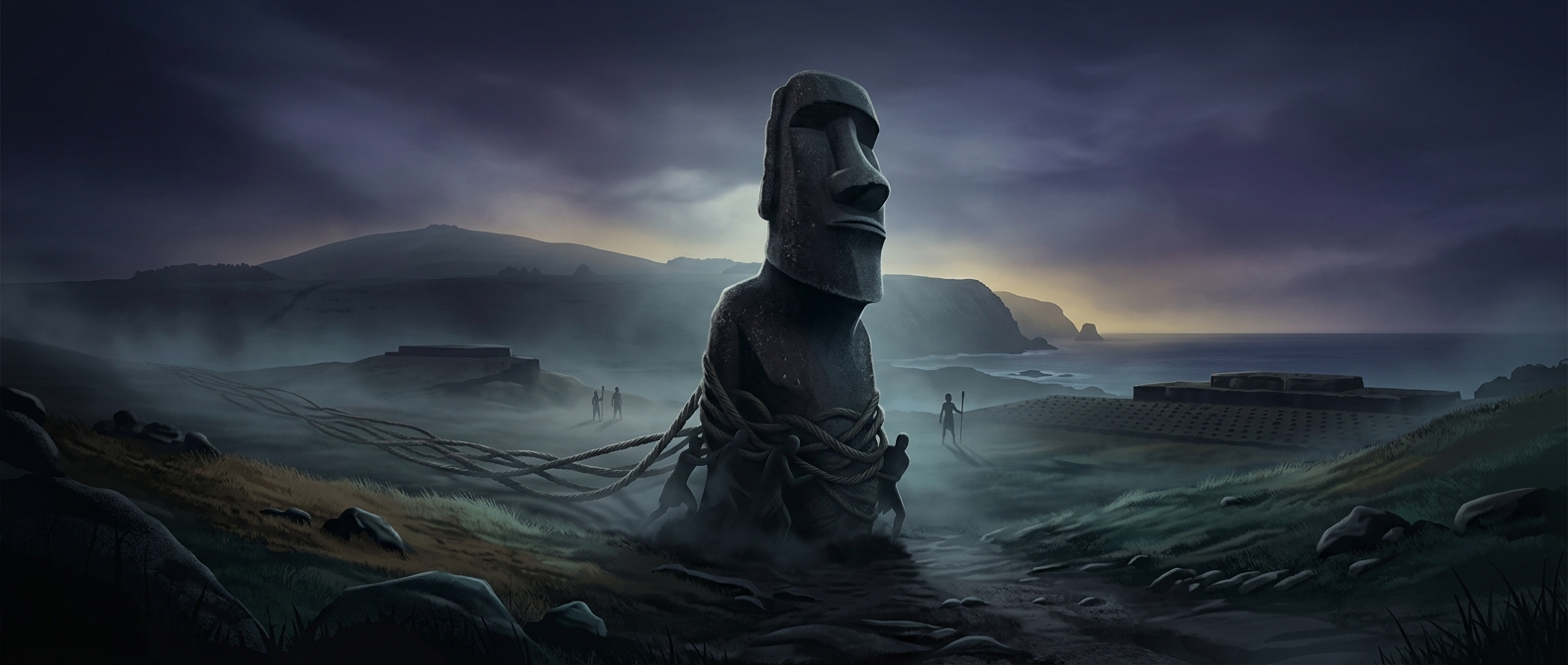
A statue balanced to move
The “walking” idea depends on a moai’s shape, not on wheels or a hidden track. Many statues are broad and heavy, but their weight is concentrated so that an upright figure can be rocked around its base. If ropes are attached on both sides and at the back, teams can pull in a coordinated rhythm: one side tips the statue forward, then the other side draws it back onto a new edge of its base. Repeating that small motion can produce slow forward progress.
Why the route mattered
A moai had to travel from a quarry to a ceremonial platform, or ahu, often across uneven ground. Keeping a statue upright could avoid the difficult work of lifting and supporting its full weight horizontally. But the method would demand careful coordination: a statue tilted too far could fall, and the ground would need to be suitable for repeated rocking. The ropes, the statue’s balance, and the pace of the pull would all have to work together.
A proposal, not a settled account
Researchers have tested versions of this approach, but the precise methods used for every statue are not known. The idea helps explain how some moai might have been moved without large wheeled vehicles, while leaving room for different techniques in different places. Its striking implication is that the statues’ familiar upright posture may have been useful not only at their destination, but during the journey itself.