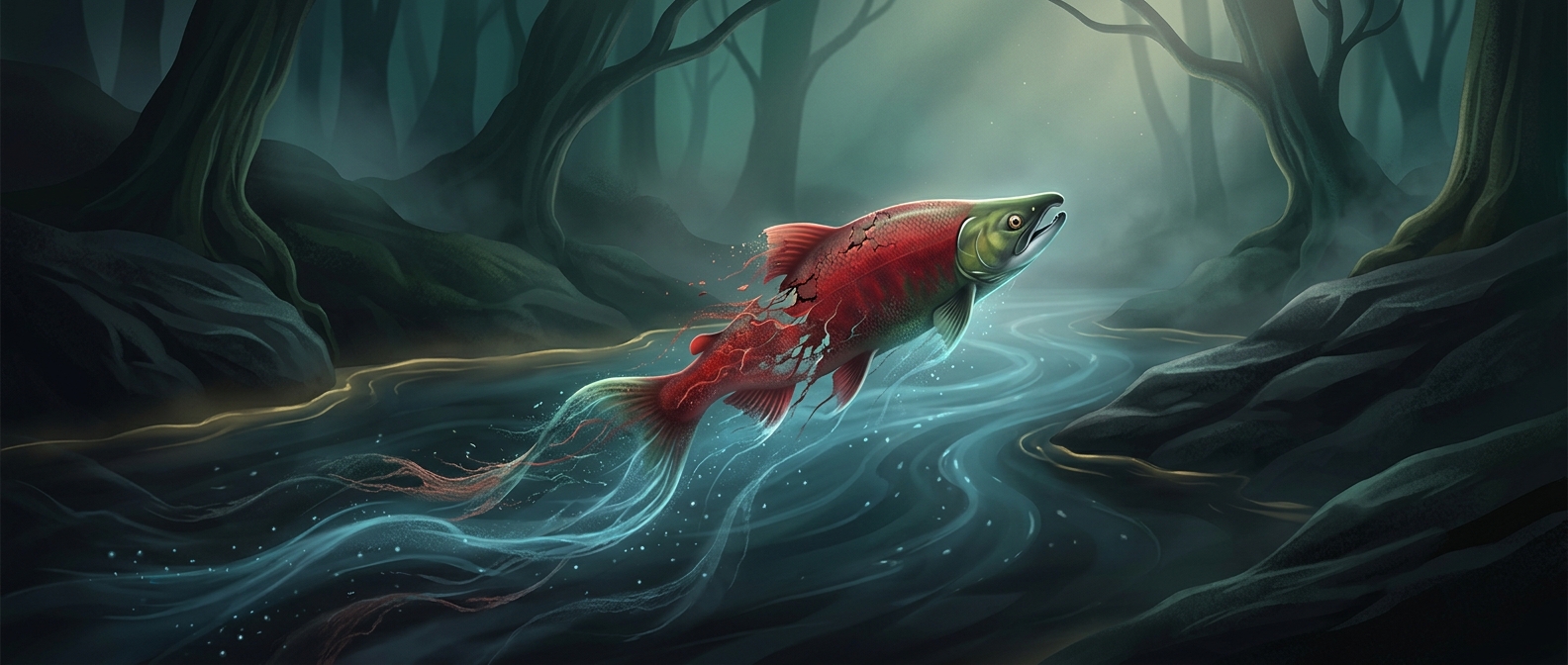
Why a Salmon’s Red Color Is Not a Sign of Strength
Sockeye salmon get their red color from carotenoids, pigments they obtain through food and store in their tissues. Before migration, those pigments are part of the fish’s reserves; as the salmon changes from ocean-feeding adult to spawning fish, pigments become concentrated in the skin. The transformation is visible, but it does not mean the fish is gaining nourishment.
The Upstream Journey Runs on Stored Energy
Once sockeye begin their spawning migration, they stop feeding. They must power swimming, navigation, and the final effort of reproduction with energy accumulated earlier. A river’s current makes the journey costly: the fish repeatedly swim against moving water, and each stretch upstream draws on finite reserves.
That is why the migration can leave a salmon physically depleted even as its colors grow more vivid. Its body is changing to support reproduction while its supply of usable energy shrinks. The red skin is a conspicuous marker of the spawning phase, not evidence that the fish has recently eaten or is in peak condition.
A Life Cycle That Ends in the River
For many Pacific salmon, spawning is the final stage of life. After laying or fertilizing eggs, adults die. Their journey therefore has a sharp biological endpoint: energy spent reaching spawning grounds and reproducing is not replenished by another meal or another migration.
The striking contrast is that the fish can look most brilliant when it is closest to exhaustion. Its color records a change in life stage; its dwindling reserves tell the story of the journey’s cost.