Why Phobos is losing ground
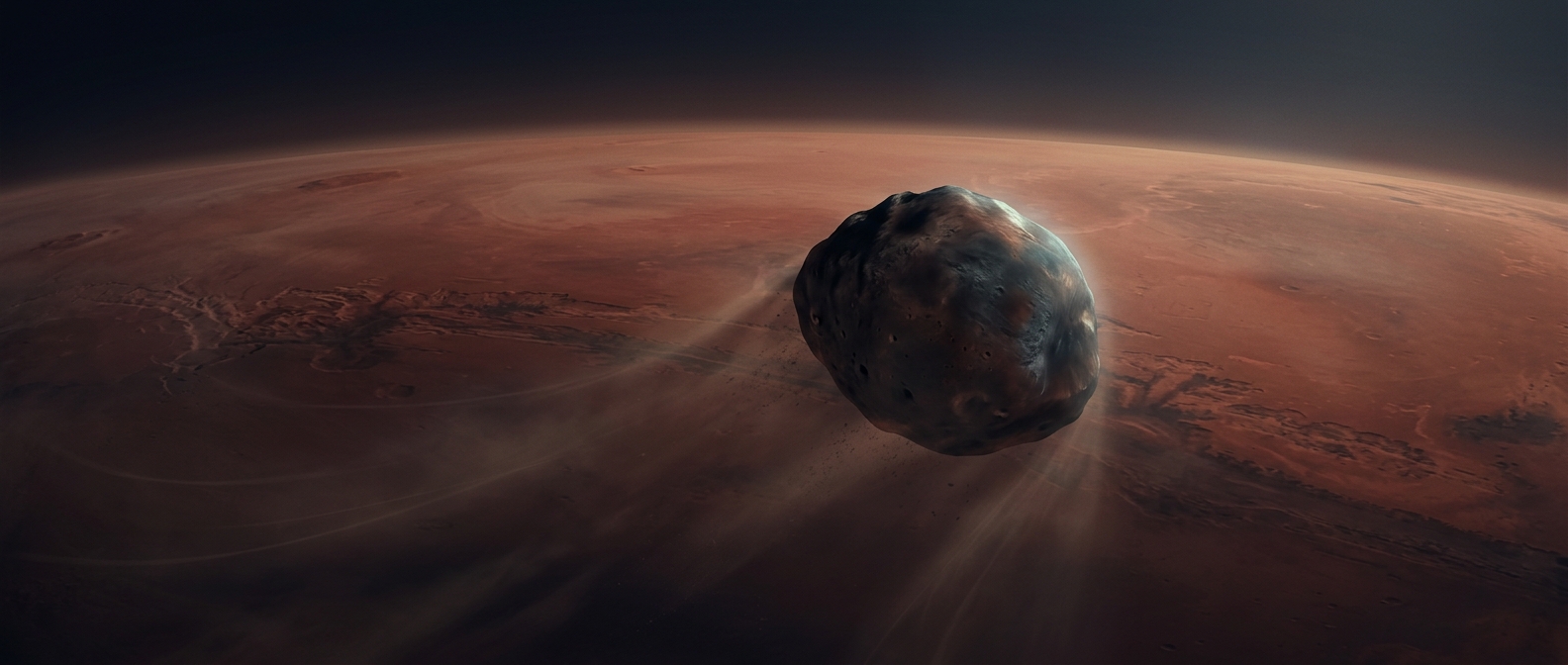
Phobos circles Mars in less time than the planet takes to rotate once. That means Phobos races over the Martian surface faster than Mars turns beneath it—and this mismatch lets Mars steadily sap the moon’s orbital motion.
Phobos’s gravity raises a slight tidal bulge in Mars, much as the Moon raises tides on Earth. Because Mars rotates more slowly than Phobos orbits, the bulge falls behind the moon instead of getting out ahead of it. The bulge’s gravity then tugs backward on Phobos, trimming its orbital momentum. The lost motion is transferred to Mars’s rotation, while tidal flexing converts some energy into heat.
A shrinking orbit, not a slowing fall
As Phobos loses orbital momentum, its path around Mars gets smaller. In a lower orbit, it actually travels faster, just as a satellite closer to a planet must move faster to stay in orbit. So Phobos is not gradually crawling around Mars; it is moving inward while continuing to race around the planet.
That inward drift brings it toward a limit where Mars’s gravity can pull much more strongly on the near side of the moon than on the far side. If those stretching forces exceed Phobos’s ability to hold together, the moon can break apart before it reaches the surface. Its fate is therefore not necessarily a single impact: pieces could instead spread around Mars, with some potentially falling later.
The planet is part of the mechanism
The process depends on the contrast between Phobos’s orbital speed and Mars’s rotation. A moon orbiting outside a planet’s synchronous orbit—the distance where it would circle in step with the planet’s rotation—can migrate outward; Phobos is inside that boundary, so the tidal exchange drives it inward. The striking consequence is that Mars’s own slow spin helps set the clock on its moon’s eventual breakup.