How Cholula’s Pyramid Became a Hill
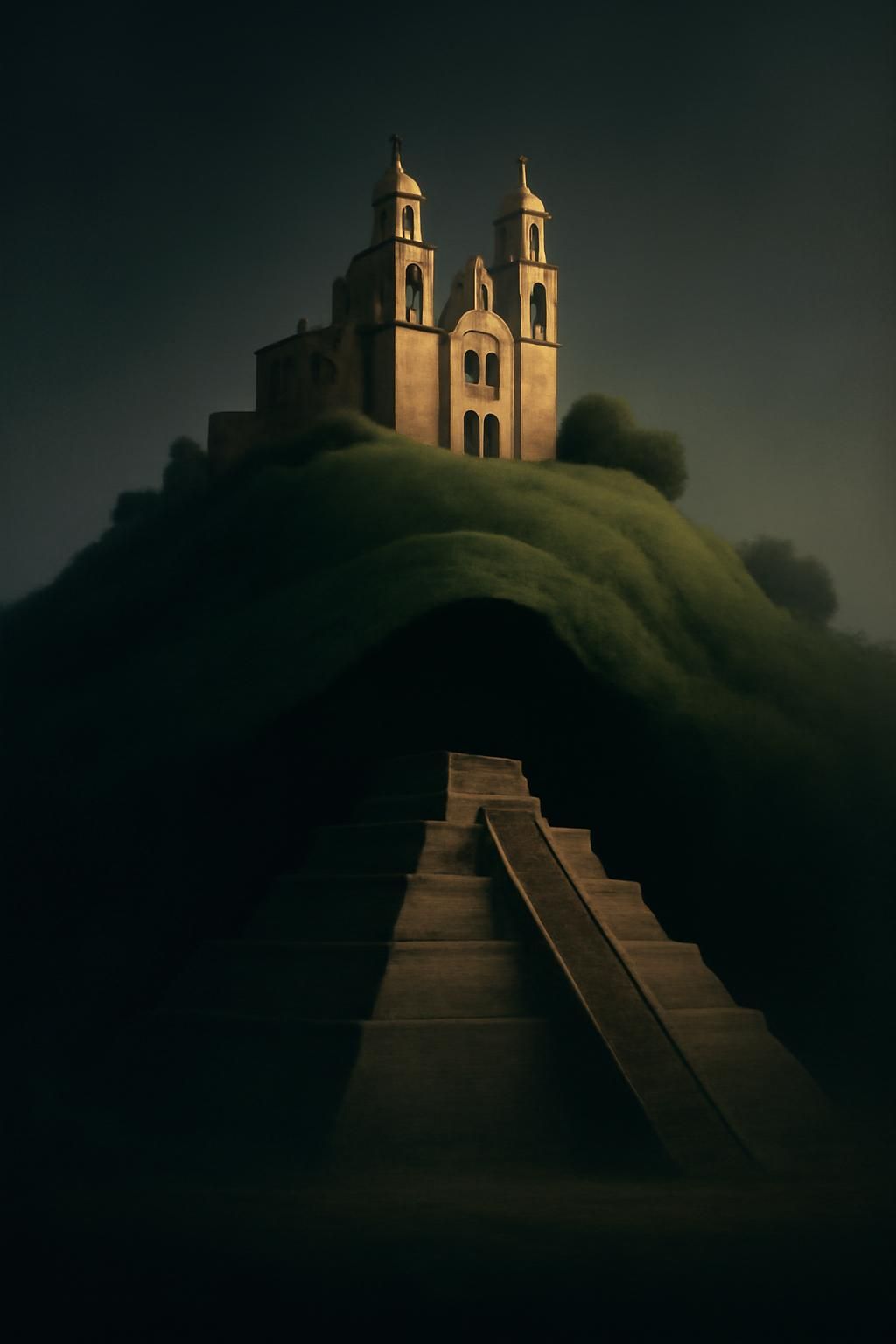
At Cholula, in central Mexico, the Great Pyramid did not disappear beneath a single layer of earth. It grew by accumulation: builders added new structures over earlier ones, expanding a sacred complex across generations. Later, soil and vegetation softened its outline until the monumental construction looked like a natural hill.
That layered form also helps explain why the site is difficult to read from the surface. The pyramid is a vast mass of successive building phases, not one exposed, sharply edged monument like the familiar image of Giza. Its base is larger than Giza’s, but the comparison is about footprint—not how much of either pyramid can be seen above ground.
A Church on the Summit
Spanish colonists built the Church of Our Lady of Remedies on the hilltop in the colonial period. The church stands above the buried pre-Hispanic complex, making the site a visible record of two eras of religious life: an Indigenous ceremonial center beneath, and a Catholic church above.
The church’s position gave the landscape a new meaning without removing the older structure. For centuries, worshippers and visitors could encounter the hill as a church site while much of its monumental architecture remained concealed within it.
The Past Inside the Hill
Archaeological tunnels and excavations have since exposed parts of the pyramid’s interior, revealing earlier construction beneath later layers. The result is less like uncovering one lost building than tracing a long sequence of rebuilding.
That is the striking consequence of Cholula’s history: the church did not simply cover a ruin. It became the landmark on top of a structure whose immense scale was hidden in plain sight, folded into the shape of the hill itself.