From a floating needle to a usable heading
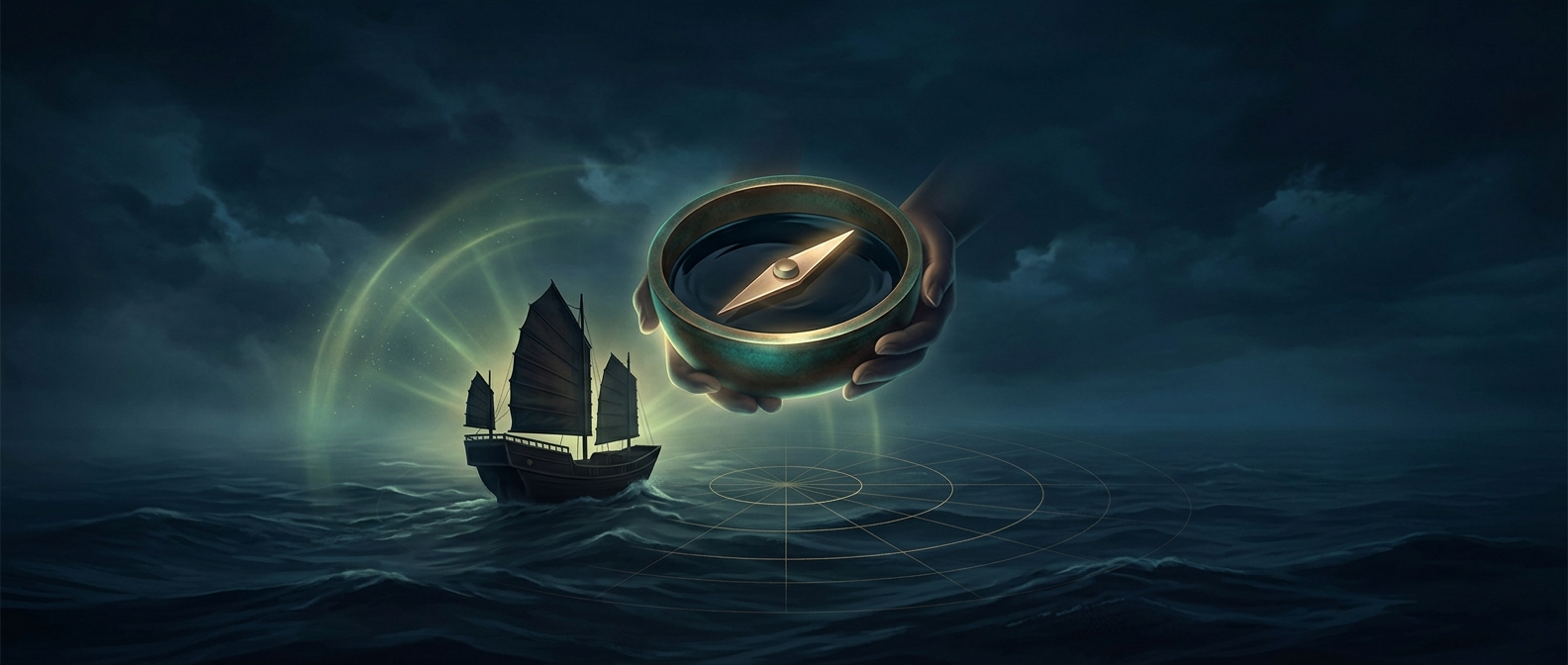
A compass did not show a sailor where a destination lay. It offered something more basic and immediately useful: a steady reference direction when familiar landmarks disappeared. In an early design, a magnetized needle floated on water in a bowl, free to turn until it aligned roughly north–south. The sailor could use that orientation to keep a chosen course rather than guess from waves or wind.
That mattered most when the sky offered no reliable guide. Stars could help establish direction on a clear night, but clouds and storms hid them. A compass brought its reference with the ship, so a change in visibility did not erase every sense of direction.
A heading was not a complete route
The device solved only one part of navigation. Knowing which way the ship pointed did not reveal its position, distance from shore, or the location of reefs. Sailors still needed accumulated knowledge of coastlines, winds, currents, and routes. A compass could help them hold a heading between recognizable places; it could not replace the experience needed to choose a safe passage.
The floating needle also had practical limits. A bowl of water could spill or slosh aboard a moving vessel, making the needle harder to read. Later compass designs kept the magnetized pointer mounted so it could turn while the ship rocked, making the instrument more suited to life at sea.
What changed at sea
The important shift was not that sailors suddenly had a perfect map, but that direction became less dependent on seeing the sky or land. With a portable reference that worked in poor visibility, crews could maintain a course through stretches when visual cues vanished. The compass turned a hidden sky into a tool they could carry aboard.