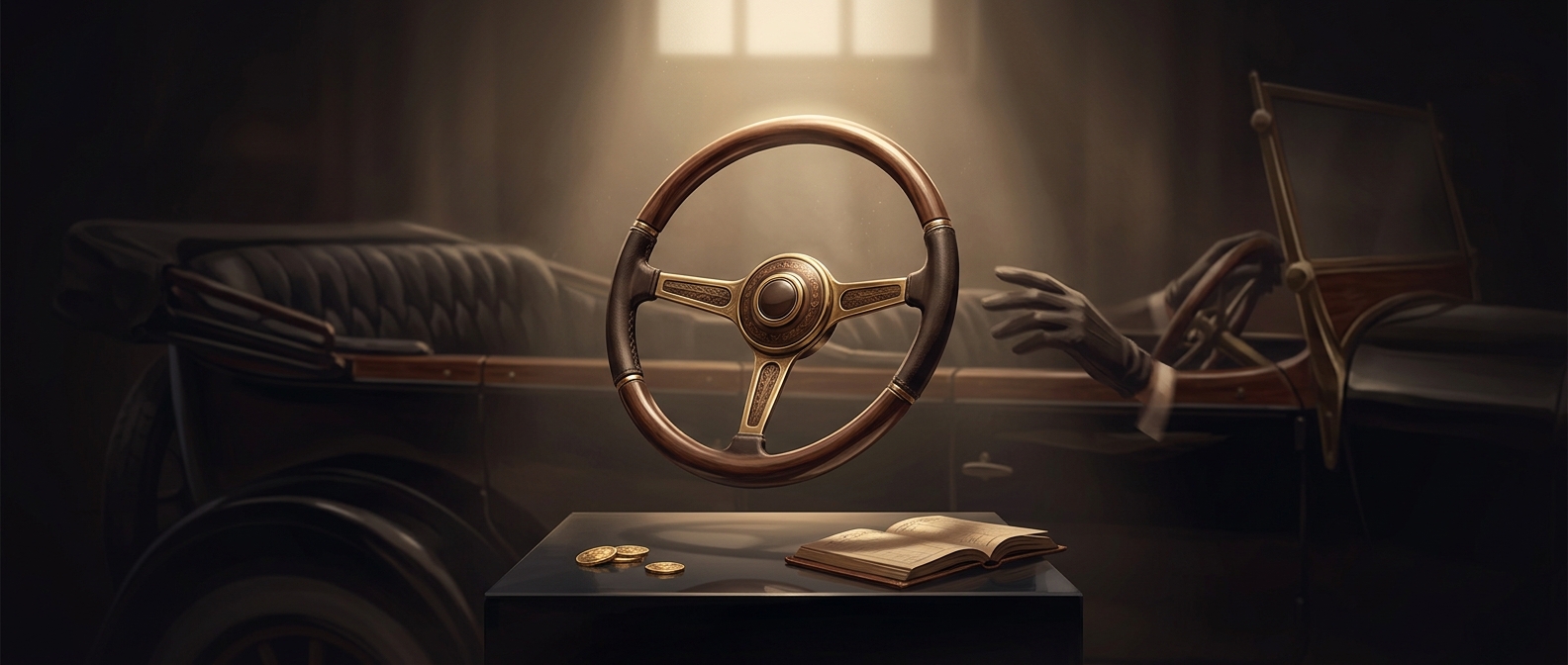
From a Lever to a Wheel
Before the circular steering wheel became standard, some early cars were guided with a tiller: a hand lever that the driver pushed or pulled to turn the front wheels. The arrangement borrowed a familiar idea from boats, where a tiller moves the rudder. In a car, though, the lever had to control the wheels through steering linkages, the mechanical connections between the driver’s hands and the front axle.
A wheel changed the driver’s relationship to that mechanism. Instead of moving a lever through a limited arc, the driver could rotate a rim in either direction, making small corrections while keeping a hand on it. Turning the rim also provided leverage: the driver could apply force over a wider circular path rather than relying on a short lever.
Why the Familiar Shape Cost Extra
The wheel was not yet the unquestioned default. Buyers could encounter it as an upgrade alongside cars equipped with tillers, so choosing the control that later became ordinary meant paying more. That extra charge reflects a moment when automakers were still offering different ways to solve the same practical problem—not a time when drivers simply expected every car to look and feel like one today.
As steering wheels took hold, driving became organized around a continuous, two-handed turning motion. The control now seems inseparable from the car, but early buyers had to decide whether that familiar circular grip was worth the added cost.