Two open slits make electrons build a wave pattern
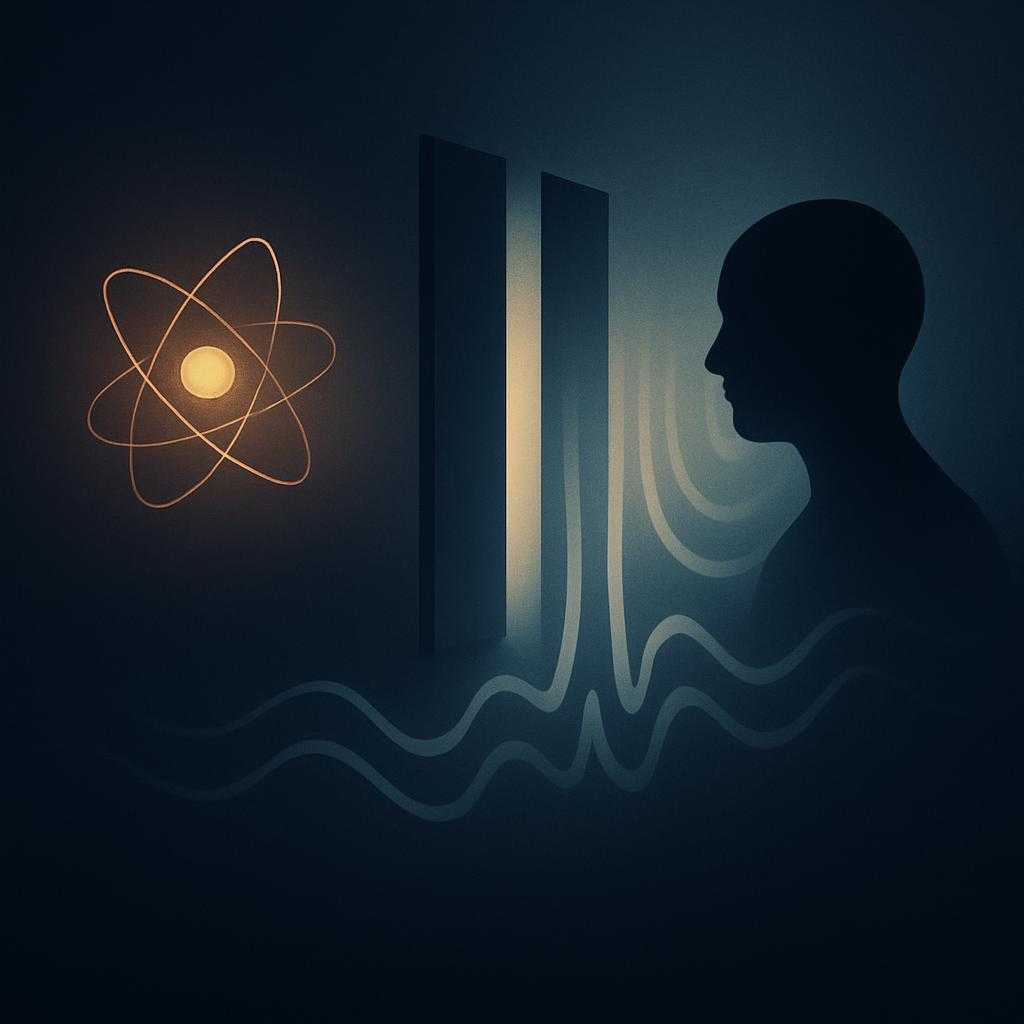
In the double-slit experiment, electrons are sent toward a barrier with two narrow openings, then detected on a screen behind it. Each electron arrives as a single localized hit. Yet when neither slit is measured, many hits gradually form alternating bands of high and low density—the familiar pattern made when waves reinforce or cancel one another.
The startling point is that the pattern appears even when electrons are sent one at a time. It is not simply a crowd of electrons bumping into each other. Quantum theory describes each electron with a wave of possible outcomes: before detection, the alternatives associated with passing through the two slits can combine, producing interference. The screen records one definite landing place, but the distribution of many landings reveals that wave-like structure.
“Watching” means measuring, not being conscious
Put a detector at the slits to learn which opening an electron uses, and the interference pattern disappears. The hits still arrive one by one, but they accumulate into a pattern more like two ordinary clusters, with no alternating interference bands.
That change is often summarized as “observation changes reality,” but “observation” here does not mean a person looking. A detector must physically interact with the electron to leave a record of its path. That interaction links the electron to the measuring equipment and disrupts the delicate relationship between the two possible paths that produces interference. Even if nobody reads the detector afterward, the path information has been recorded in the physical setup.
A quantum object resists either-or answers
The experiment does not show that an electron is simply a tiny ball secretly taking one known route while nobody checks. Nor does it mean the electron is a literal water wave spread through space. It shows that familiar categories—particle with one definite path, or wave spread across both slits—do not fully describe what happens between preparation and measurement.
The practical lesson is precise: whether interference appears depends on whether the experiment preserves or records information about the path. The apparatus is part of the phenomenon, not a passive window onto it.