A movie gesture became an animated signature
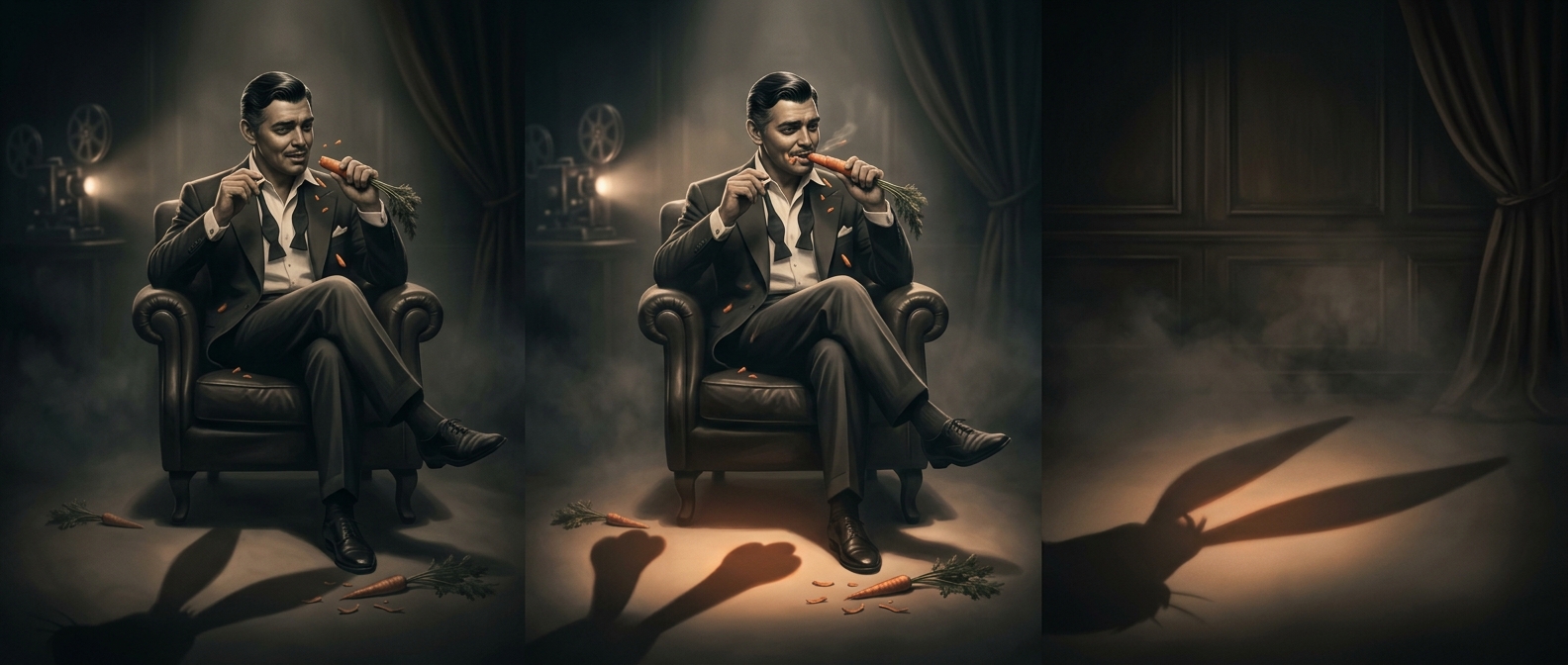
In It Happened One Night (1934), Clark Gable’s character leans against a fence, munches a carrot, and keeps talking with his mouth full. The casual combination of chewing and conversation was funny because it made the character seem relaxed and unconcerned with manners. Bugs Bunny’s familiar carrot-chomping drew on that bit of screen business.
The connection is more specific than saying Bugs was modeled on Gable. It was a borrowed comic gesture, not a blueprint for the rabbit’s whole personality. Animation could take the small behavior and make it instantly readable: a carrot appears, Bugs takes a bite, and the chewing becomes part of his unhurried, wisecracking presence.
Why the gag suited Bugs
A carrot gives an animator a simple prop that can do several jobs at once. It makes the character’s pauses visible, gives him something to chew while he talks, and can punctuate a joke without interrupting the scene. Repeated across cartoons, the behavior became shorthand for Bugs himself—even for viewers who had never seen Gable’s film.
That is how a fleeting live-action moment can outgrow its source. Gable’s carrot-eating was one scene; Bugs’s version became a recurring piece of character design, so recognizable that the rabbit and the vegetable are now difficult to imagine separately.