A newspaper page became a game’s letter supply
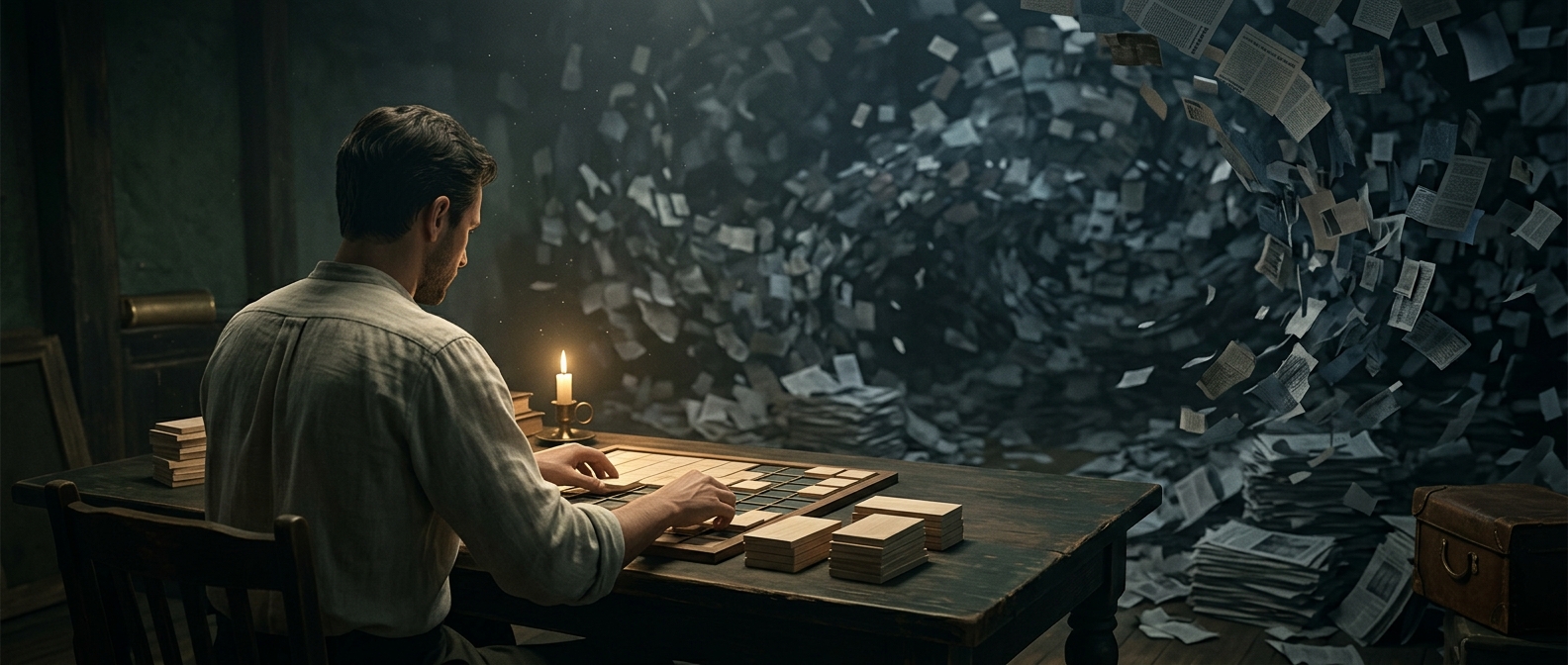
When Scrabble’s inventor, Alfred Mosher Butts, worked out the game’s letter mix in the 1930s, he treated spelling as something that could be counted. He tallied letters from a newspaper page and used their relative frequency to decide how many of each tile the game should contain. The result was a miniature model of the English he saw in print—not a distribution designed to keep pace with every word people might use decades later.
That choice shapes the game before anyone plays. Frequent letters such as E and A appear on many tiles, so players are more likely to draw them. Uncommon letters are scarce; their tiles carry higher point values, compensating for the difficulty of finding a place to play them. The balance is deliberate: plentiful letters help build words, while a rare letter can pay off when a player fits it onto a valuable square.
The vocabulary moved on; the bag did not
Language keeps changing, but a fixed tile set cannot adjust when new terms become familiar. A modern word may be perfectly ordinary and still be hard to spell with a hand full of tiles—especially if it needs a letter that appears only a few times. That is not a judgment about whether the word belongs in English. It is a consequence of the game’s old inventory and the luck of the draw.
The same constraint is part of Scrabble’s strategy. Players must decide whether to hold an awkward letter, use it quickly, or build around the letters already on the board. A word can be common in conversation and still feel like a rare resource in the game: the newspaper-era odds are sitting right there in the rack.