A New Engine for an Old Satellite
A communications satellite can still broadcast perfectly while becoming difficult to keep in the right place. In geostationary orbit, where satellites circle at the same rate Earth turns, a spacecraft appears to hover over one region. Small gravitational tugs from the Moon and Sun gradually pull it off its assigned position, so it needs periodic engine burns to stay there.
Intelsat 901 had spent 19 years in orbit when its own propulsion could no longer perform that job. Rather than replace the entire satellite, MEV-1 brought a working propulsion system to it.
How the Tow Works
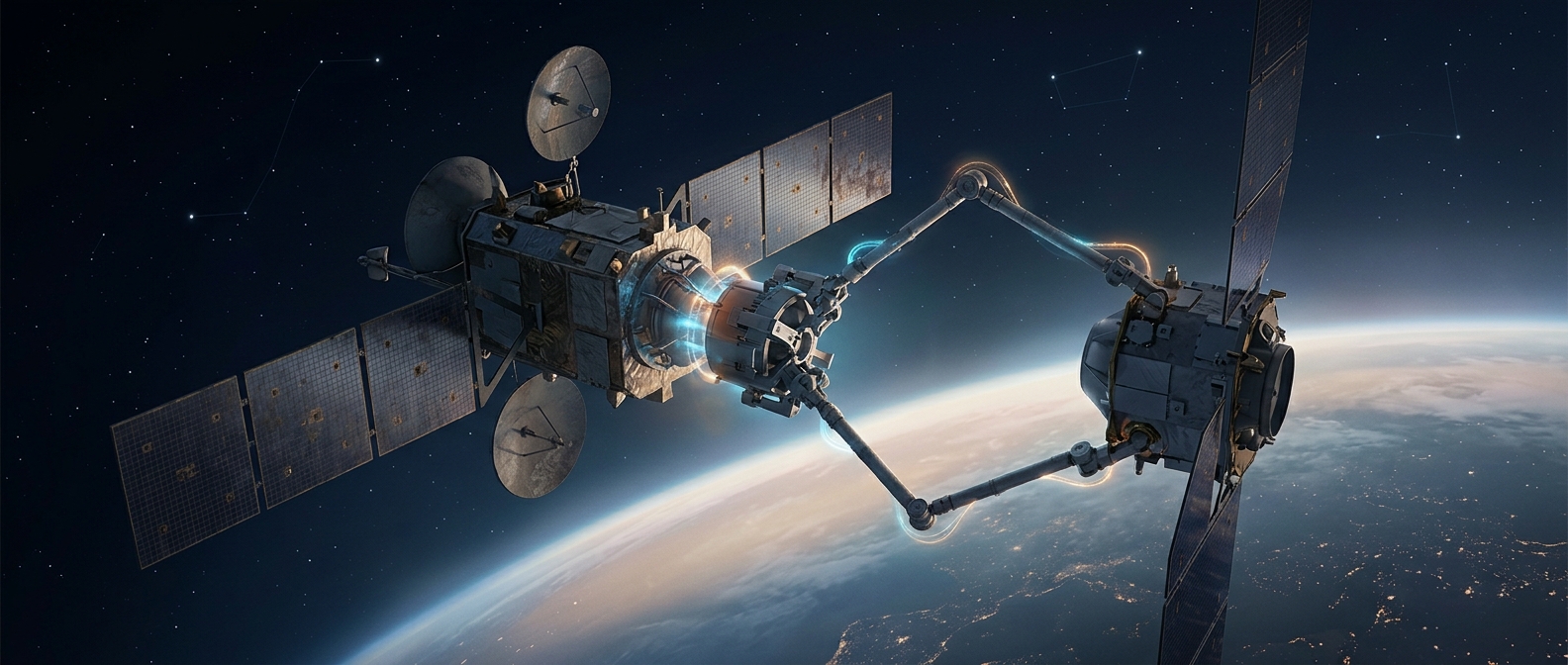
MEV-1 approached the satellite and latched onto a ring left over from its launch. That connection let the two spacecraft move as one. MEV-1 then used its own engines and control systems to handle the orbit adjustments that Intelsat 901 could no longer make.
The key distinction is that MEV-1 did not repair or restart the old satellite’s thruster. It supplied the missing capability from the outside. Intelsat 901 could keep doing its communications work while its attached companion supplied the push needed to maintain its position.
Why Docking Matters
Most satellites were built to launch and operate, not to meet another spacecraft years later. A servicing vehicle therefore has to find and approach an object that was not designed for routine repair, then make a secure connection without disrupting its operation. MEV-1 demonstrated that an aging satellite could be given more useful life without replacing its communications hardware.
For operators, that can mean postponing the costly transition to a new spacecraft while continuing to use an existing one. The striking part is the simplicity of the idea: instead of throwing away a working satellite because its engine has failed, attach another engine and let the pair carry on.