Why a Tensioned Rope Can Snap Back
A loaded rope behaves a little like a stretched spring. Pulling on it makes its fibers elongate, even if the change is too small to notice. The fibers resist that stretch, and the work put into pulling the rope is stored as elastic energy. The harder the pull and the more the rope stretches, the more energy is available to drive movement if the line suddenly fails.
When the Line Lets Go
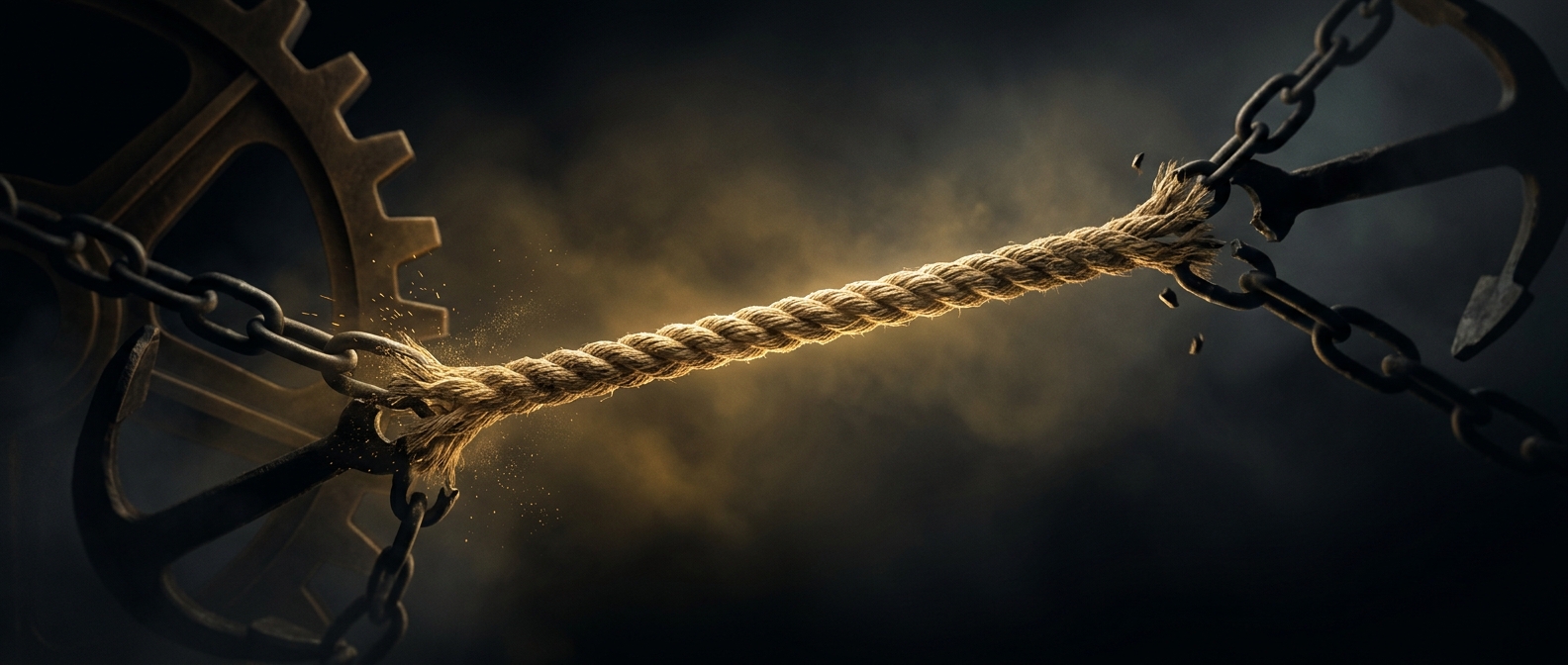
If the rope breaks, the tension that had been holding it taut disappears at the break. The rope’s stretched sections contract toward their relaxed length, sending a release of motion along the line. Depending on how it is secured and what it is holding, one or both ends can whip through the air. A heavy load may also drop or shift, adding another hazard.
The path is not always a simple straight line: knots, attachment points, rope material, and the direction of the pull affect how it recoils. But the essential danger is the same—the rope itself can move suddenly and forcefully, even after the load is no longer supported.
The Danger Zone Is Larger Than the Break
People often focus on the object being lifted or pulled. Yet anyone standing near the rope, its ends, or the area it could sweep through may be in danger. In games, this makes a taut line more than a visual sign of strain: it signals that a sudden failure could turn the rope into a fast-moving hazard. The risky space is the rope’s potential path, not just the point where it might snap.