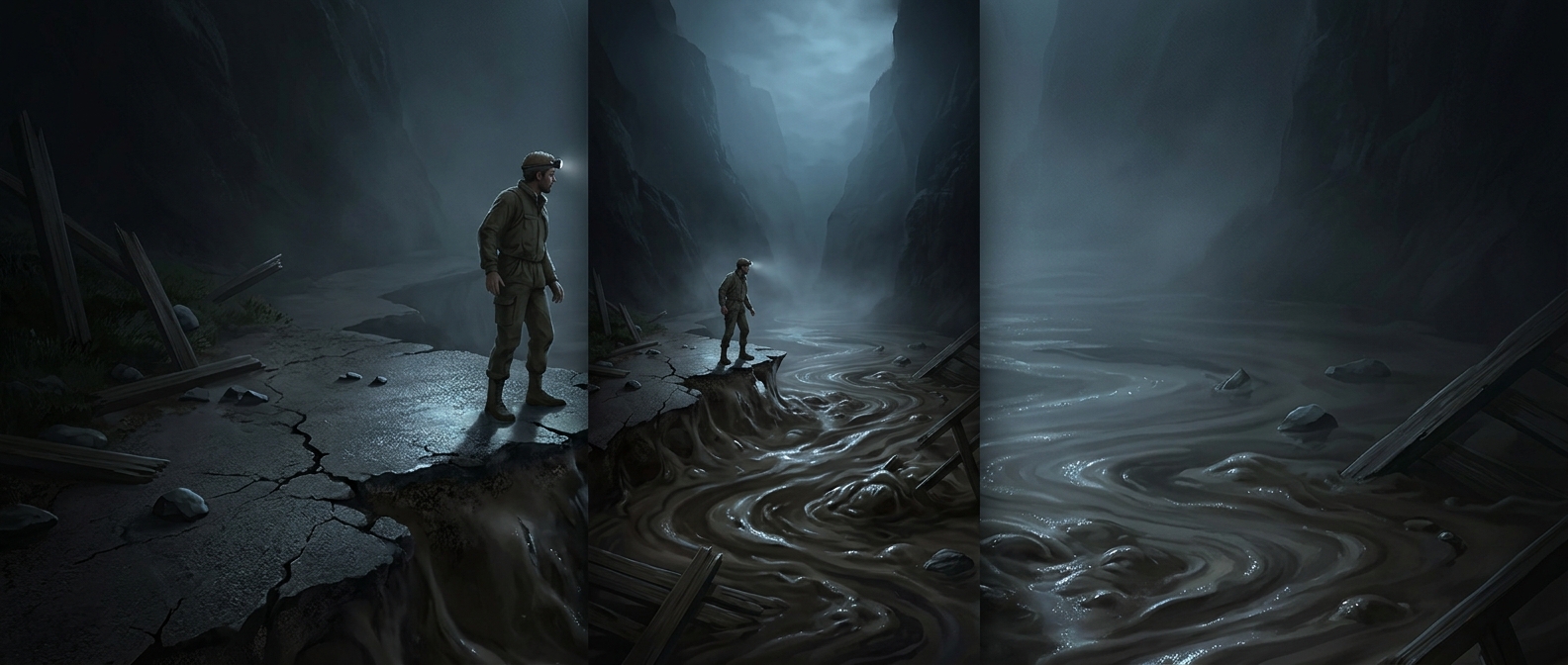
How shaking takes the load off soil grains
Loose, water-saturated soil is a network of grains with water filling the gaps. At rest, the grains press against one another, and friction at those contacts helps the ground support weight. During an earthquake, repeated shaking makes the grains shift and try to settle into a tighter arrangement. If the water cannot escape quickly, it takes on more of the pressure that had been carried through grain-to-grain contacts.
Engineers call this liquefaction. The soil need not become a pool of liquid: the key change is that its grains lose much of their contact and friction, so the ground temporarily behaves less like a stable framework and more like a dense slurry.
Why buildings can sink or tilt
A foundation depends on surrounding soil to resist its load. When shaking weakens that support, a building may settle unevenly, tilt, or move sideways with the ground. The structure does not have to be unusually heavy; even a sound building can be damaged if the soil beneath it loses strength.
The effects can continue after the strongest shaking. As excess water pressure dissipates and the grains settle back into contact, the ground may compact and sink, leaving foundations or buried infrastructure displaced. On sloping or waterfront ground, weakened soil can also spread laterally, carrying roads and structures along with it.
That is why a site’s underground conditions matter as much as what is visible at the surface: firm-looking ground can conceal loose, waterlogged layers that become unreliable when shaken.