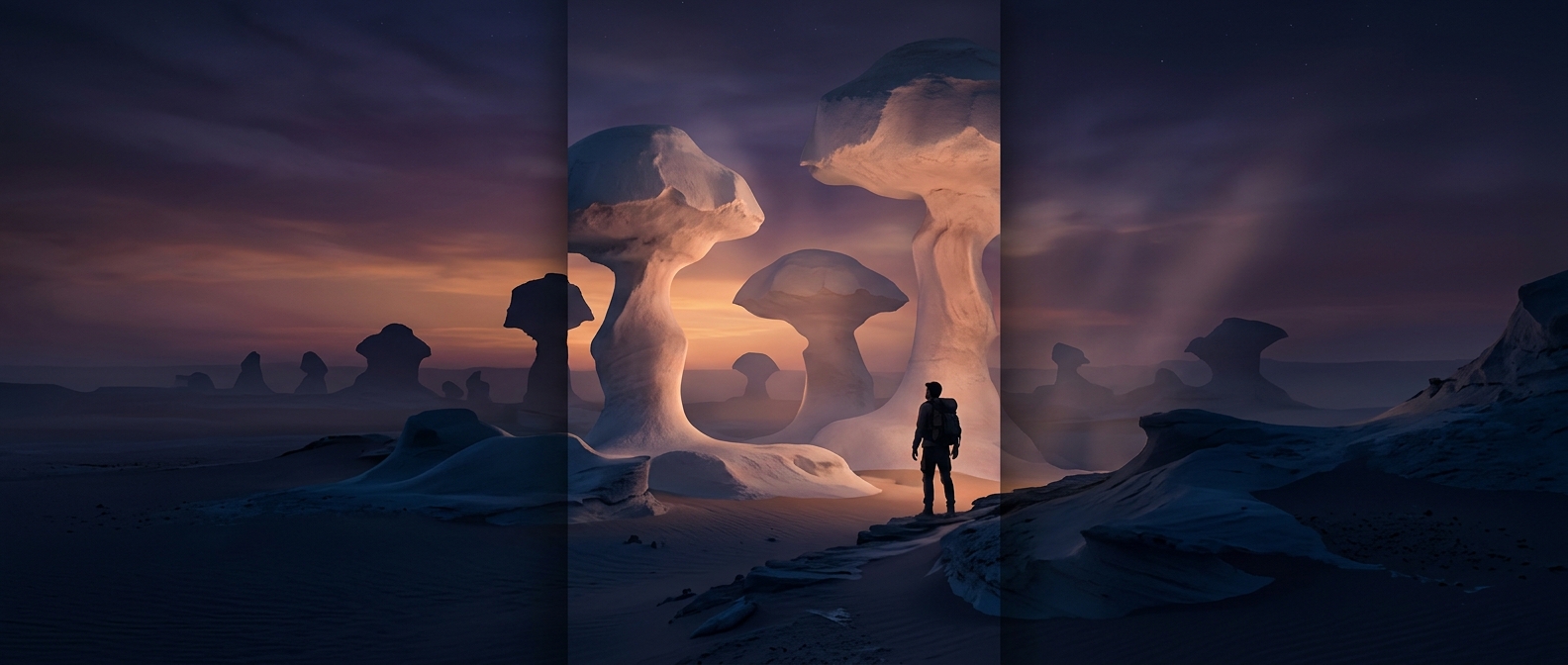
Why the White Desert’s rocks resemble mushrooms
The shapes are the result of erosion working unevenly. The White Desert’s pale rock is chalk, a soft limestone that can be worn down by wind-blown sand. Near the ground, gusts carry sand grains that scrape and chip at exposed rock; higher up, fewer grains may strike with the same force. Over time, the lower part of a formation can narrow while a broader top remains, producing the familiar mushroom-like outline.
The process is not a sculptor’s precise carving. Wind direction, the rock’s structure, and differences in how quickly its layers wear away all help determine the final shape. That is why the desert contains many distinct silhouettes rather than a field of identical stone caps.
A landscape shaped by small, repeated impacts
The White Desert lies in Egypt’s Western Desert, near the Farafra Oasis. Its chalk formations stand out against the surrounding sand because the pale rock catches the light and makes each contour easy to see. What looks like a single dramatic act of carving is instead the accumulated effect of countless grains striking the same surfaces, gradually turning ordinary differences in the rock into striking forms.
The mushroom shapes are therefore more than a visual oddity: they reveal where erosion has been most effective. A narrow base beneath a broad cap is a record of the wind’s repeated work, made visible in stone.