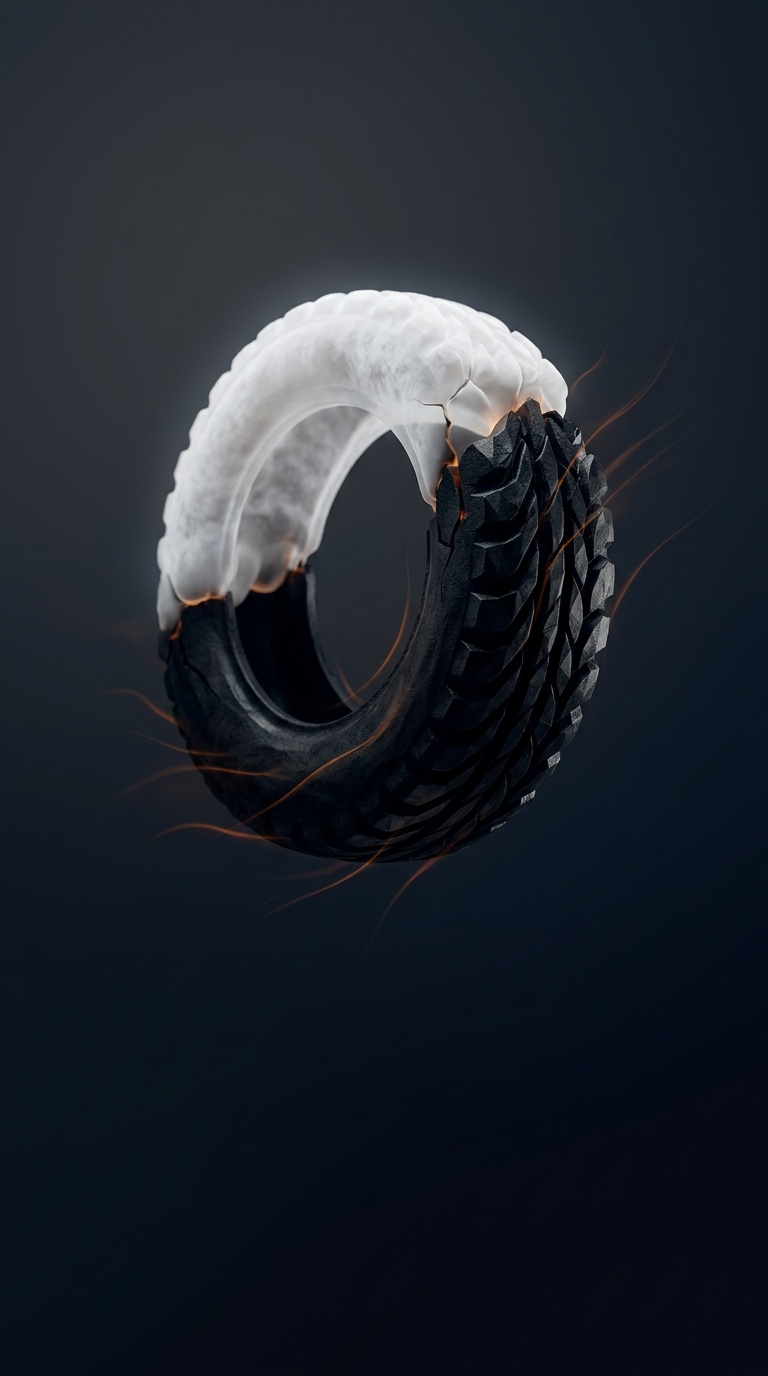
How a pale material became tire armor
Rubber is naturally light-colored, but on its own it is too soft and vulnerable to make a durable tire. A tire flexes thousands of times as it rolls, while its tread is scraped by pavement and exposed to sunlight. The challenge was not simply to color the rubber; it was to help it withstand that repeated punishment.
The key ingredient is carbon black, a fine form of carbon mixed through the rubber compound. Its tiny particles interact with the rubber’s molecular network, helping the material resist tearing and abrasion. Because carbon black also absorbs ultraviolet light, it helps shield rubber from sunlight-driven damage that can make it brittle.
The color is a side effect of the reinforcement
As the particles spread through the compound, they turn the rubber dark. That black appearance is therefore tied to a material choice with a mechanical purpose, rather than being a decorative coating. The additive is inside the rubber itself, so it does not simply wear off as the tire meets the road.
Tires are made from carefully chosen compounds, and their demands vary: tread must grip and resist wear, while other parts of the tire have different jobs. Carbon black is one tool for tuning rubber’s strength and durability, not a universal recipe that makes every tire behave identically.
The practical consequence is visible on every drive: the dark tread is not just a color that happens to suit pavement. It is evidence of reinforcement built into the material, helping a tire keep its shape and survive the long cycle of flexing, friction, and sun.