A march that disappears from the record
Herodotus places the expedition in the reign of Cambyses, the Persian king who had conquered Egypt. In his account, Cambyses sent an army from Thebes toward the Ammonians, the people of an oasis community in the western desert. Its orders were to subdue them and destroy their oracle.
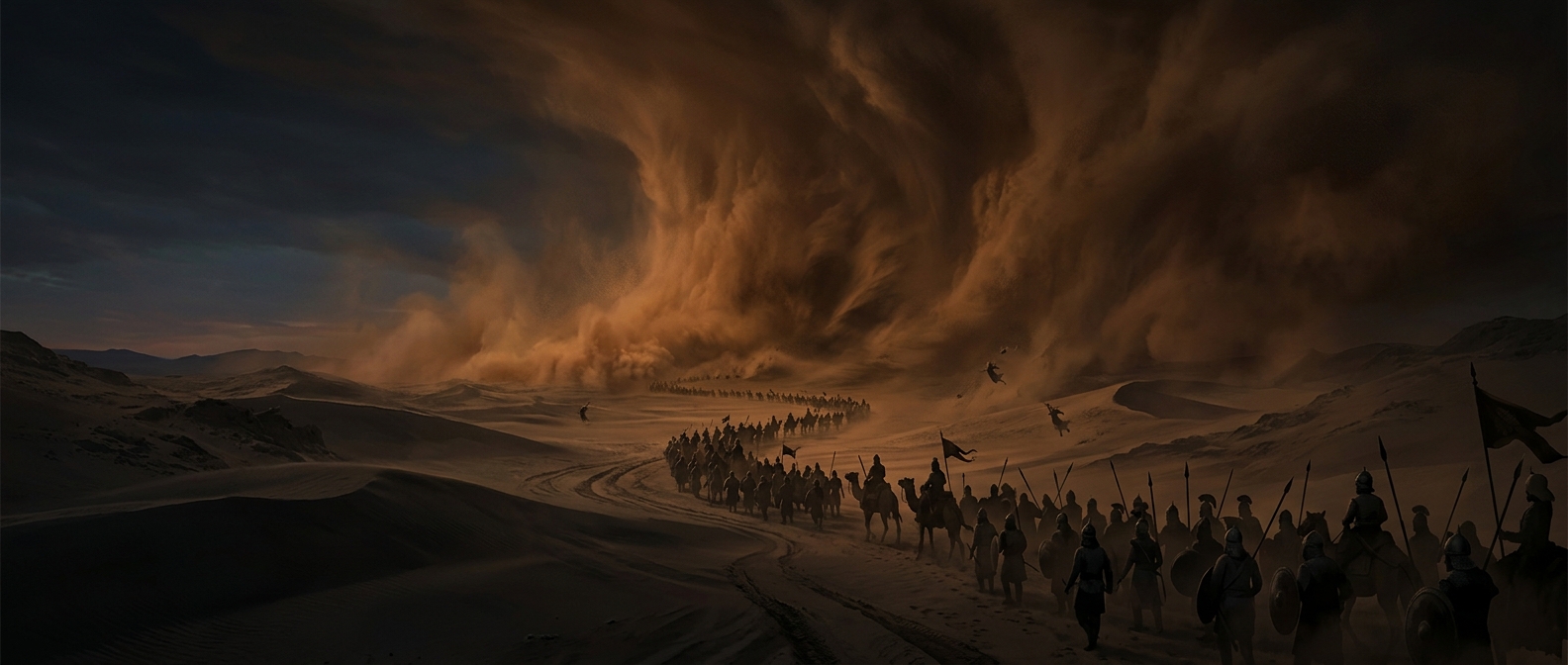
The route first led to an oasis, then across a long, waterless stretch. Herodotus says the soldiers had gone about halfway when a violent sandstorm swept over them. Afterward, he writes, the army was never seen again.
Why the desert matters to the story
An army crossing open desert faced more than heat. It needed to carry or find water, keep its bearings where landmarks were scarce, and remain together over difficult ground. A sandstorm could obscure the landscape and make navigation hazardous; if a force became scattered far from water, a small disruption could turn into a catastrophe. Herodotus’s account offers a vivid image of how completely the desert could swallow a campaign.
But the story’s certainty ends with the report itself: Herodotus gives no surviving witness to explain what happened, and the army’s fate cannot be independently reconstructed from his account. The striking point is not simply that a storm might have killed thousands. It is that, in the story, an imperial force set out to impose the king’s will—and the terrain made it vanish beyond the reach of the very record meant to preserve its passage.