The story Mary Shelley could not yet tell
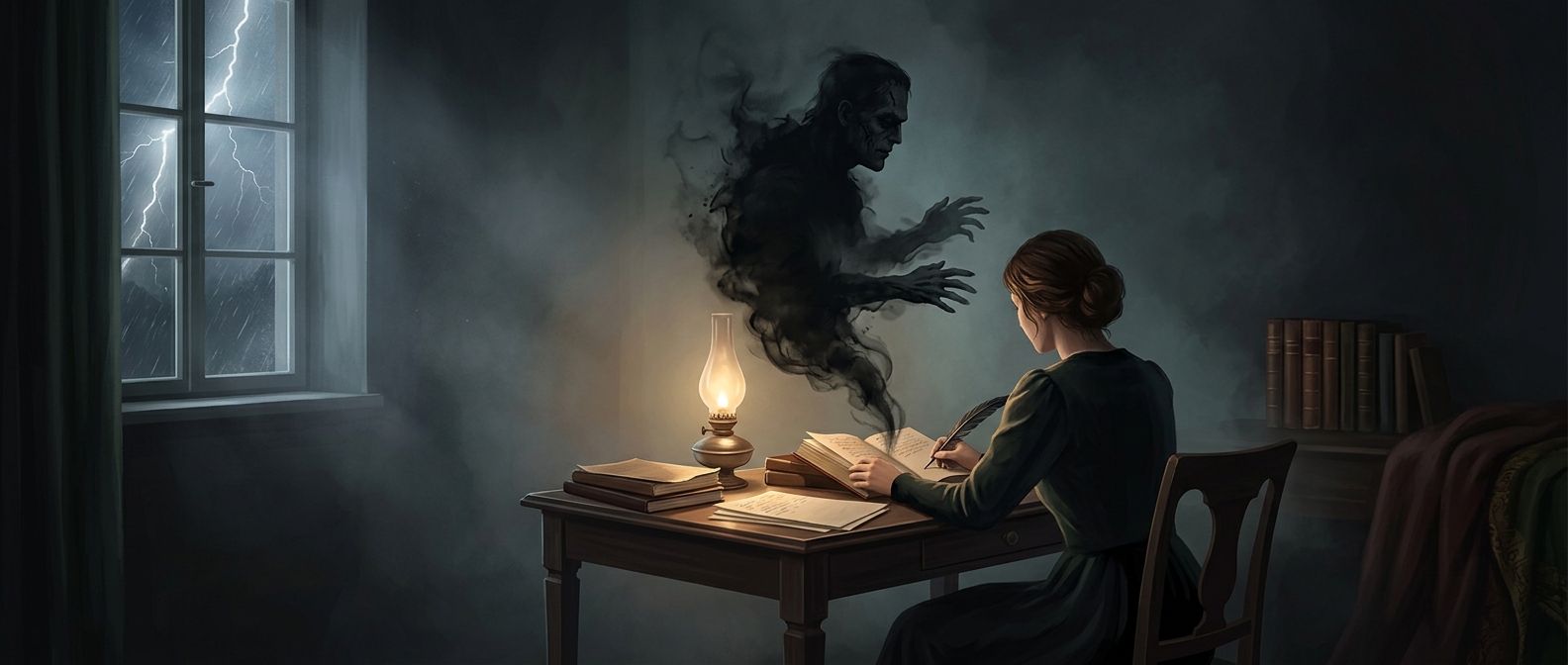
The teenager was Mary Godwin, later known as Mary Shelley. In 1816, while staying near Lake Geneva with the poet Percy Bysshe Shelley and a circle that included Lord Byron and physician John Polidori, she struggled to invent a ghost story for their writing challenge. The group’s conversations about life, death, and scientific experiments gave her a way into the problem: instead of asking what ghost might appear, she began imagining what would happen if a human being tried to create life.
That shift became Frankenstein. Its horror does not depend mainly on a supernatural monster. The creature is made by a person, and the dread grows from the creator’s decision to abandon what he has brought into the world. The danger is both physical and moral: scientific ambition becomes frightening when responsibility stops at the moment of creation.
A new kind of monster story
Shelley’s approach helped make horror feel at home in the modern world. The source of terror was no longer only an ancient curse or an unseen spirit; it could be a human choice, made with knowledge and tools. That made the fear uncomfortably recognizable—and left readers asking who bears responsibility when an invention causes harm.
The same gathering also produced another influential work: Polidori’s The Vampyre, which helped shape the literary vampire as a charismatic humanlike figure. But Shelley’s contribution reached beyond a new creature. By locating horror in the consequences of creation, she gave later writers a durable way to make progress itself frightening.