Why One Pair Could Serve Two Distances
As people age, the eye’s natural lens gradually becomes less flexible. A young eye can change the lens’s shape to focus on a nearby page; with reduced flexibility, close work becomes harder even when distance vision remains useful. This age-related difficulty is called presbyopia.
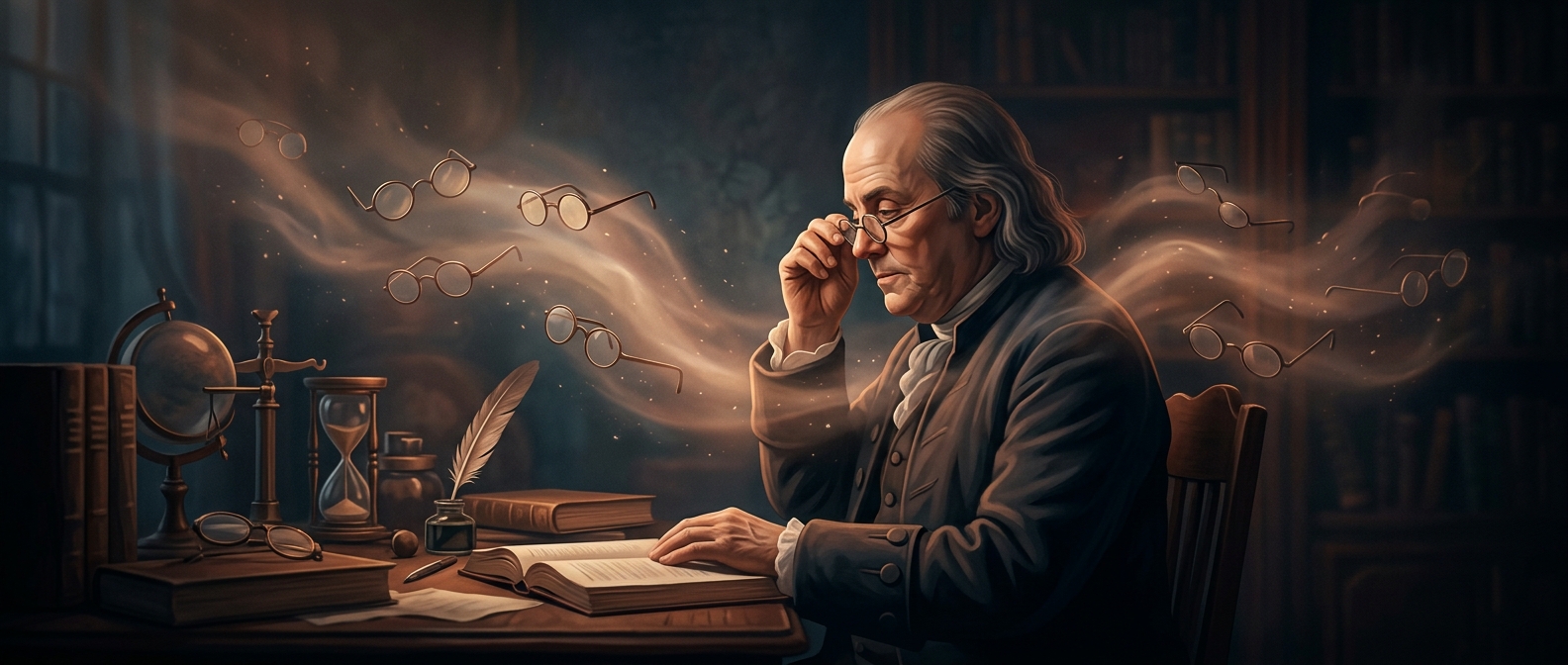
Reading glasses help by adding magnifying power, but that power makes distant objects look blurred. Separate pairs solve each task, yet switching between them interrupts ordinary activities—reading a page, then looking up at someone across the room.
A Lens Divided by the Way You Look
A bifocal puts two optical powers in one frame. The upper portion is for distance, while the lower portion magnifies nearby text. To read, the wearer looks down through the lower section; to see farther away, the wearer looks through the upper one.
The clever part is not that the eye changes focus more effectively. The glasses provide the appropriate correction in different parts of the wearer’s field of view, so a small shift in gaze replaces a change of spectacles. The visible division between the lens sections marks that change in power.
A Practical Compromise
The design makes moving between near and far tasks easier, but it also asks the wearer to aim through the right part of the lens. Looking straight ahead at something close may not bring it into focus, and the boundary between the sections can be noticeable. Bifocals trade the convenience of one pair for the need to learn where each view lies.
That tradeoff is what made the arrangement useful: a reader could lower their eyes to a page and then look up across the room without reaching for another pair.