A pattern hiding in miles of chart paper
In 1967, graduate student Jocelyn Bell Burnell was helping build and operate a radio telescope at the University of Cambridge. The instrument did not make pictures of the sky. It traced radio signals as a continuous line on long rolls of paper, leaving researchers to scan the marks for anything unusual.
Bell Burnell noticed a faint, repeating signal that appeared at precise intervals. It was easy to mistake for interference, but its regularity set it apart. She kept tracking it, checked that it came from the sky rather than the equipment, and found more examples. The first signal repeated roughly once every 1.3 seconds—far faster and more steadily than known astronomical sources seemed able to manage.
What could pulse that steadily?
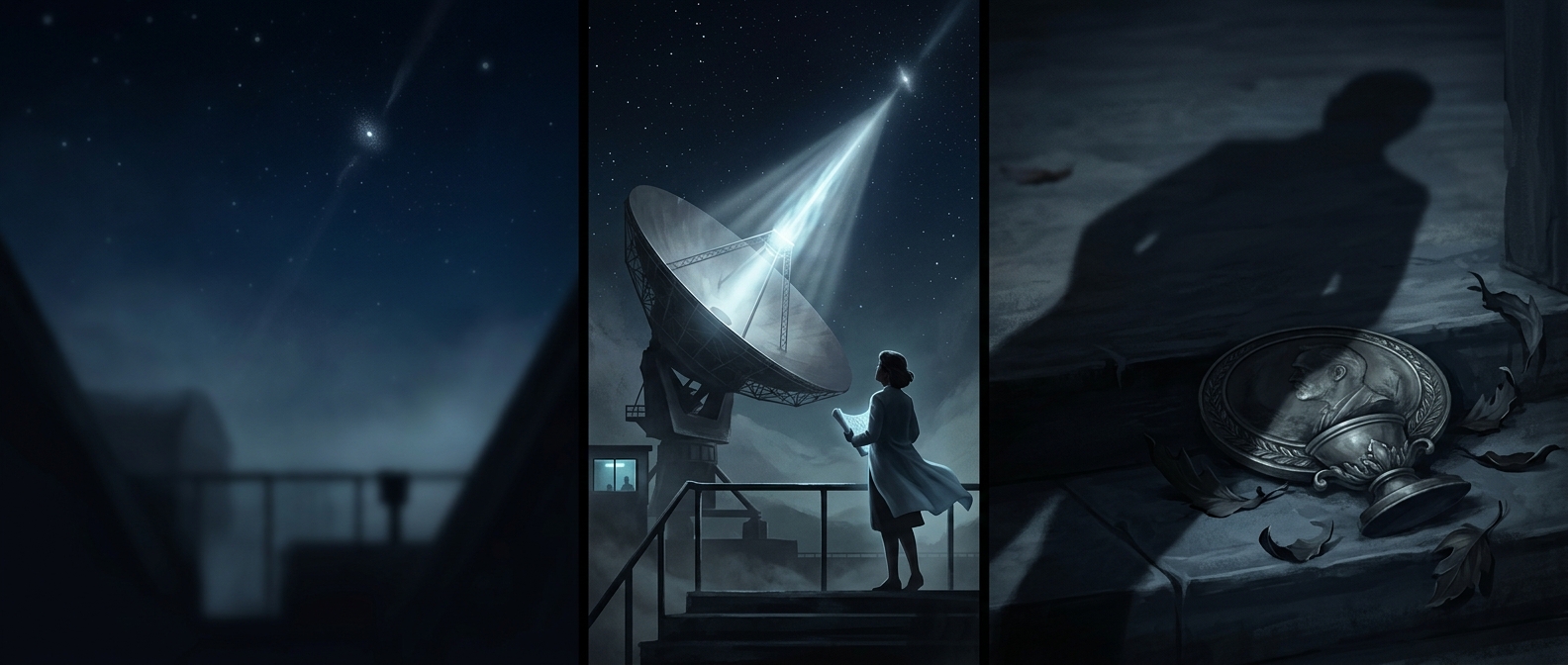
The answer was a pulsar: a rapidly rotating neutron star, the compact remnant left when a massive star explodes. A neutron star’s magnetic field channels radio emission into narrow beams. If a beam sweeps across Earth as the star spins, radio telescopes detect a pulse each time it points our way—much like seeing a lighthouse flash, though the source is a star-sized object.
The discovery gave astronomers a new way to study matter under extreme conditions. A star that had collapsed into a city-sized sphere could rotate with remarkable regularity, making its pulses useful as precise cosmic clocks. The signal on Bell Burnell’s chart was not merely a curious blip; it revealed an entirely new kind of astronomical object.
The discovery and the Nobel Prize
Bell Burnell’s role became the focus of debate when the 1974 Nobel Prize in Physics recognized Antony Hewish, her supervisor, and Martin Ryle for work in radio astronomy. Bell Burnell was not included, despite having found and pursued the first pulsar signal as a graduate student.
The episode left a lasting question about how scientific credit is assigned, especially when a junior researcher makes a crucial observation within a senior researcher’s project. The discovery began with an anomaly easy to overlook: a small, steady tick buried in a vast stretch of paper.