How lasers can draw a shape in midair
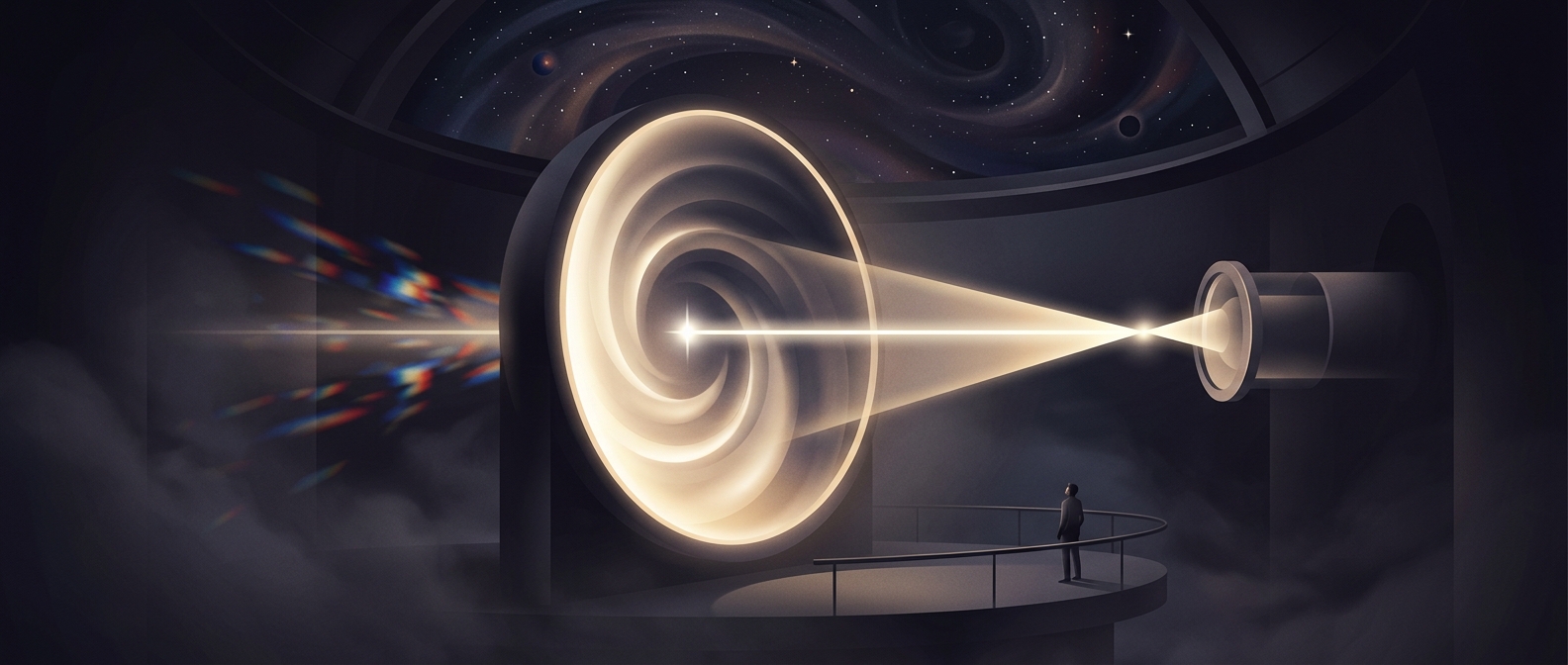
A laser beam is usually hard to see from the side because most of its light travels straight ahead. To make a visible point in open space, a display needs something to scatter light toward the viewer—or a process that makes the air itself glow.
One approach uses optical trapping: carefully arranged laser light holds a microscopic particle in place, much as a moving current can suspend dust. By steering the trapped particle rapidly through a sequence of positions and lighting it, a system can make it trace out a shape. The eye retains each brief flash for a fraction of a second, so a fast-moving point can look like a continuous line or solid form. This is called persistence of vision.
Why the result looks three-dimensional
Unlike a flat screen, the moving point occupies different positions in real space. Light from it reaches the viewer from those positions, giving the eyes changing angles and depth cues as the viewer moves. The apparent object is still an illusion: there is no solid surface where the outline seems to be, only a particle being repositioned too quickly for the eye to follow.
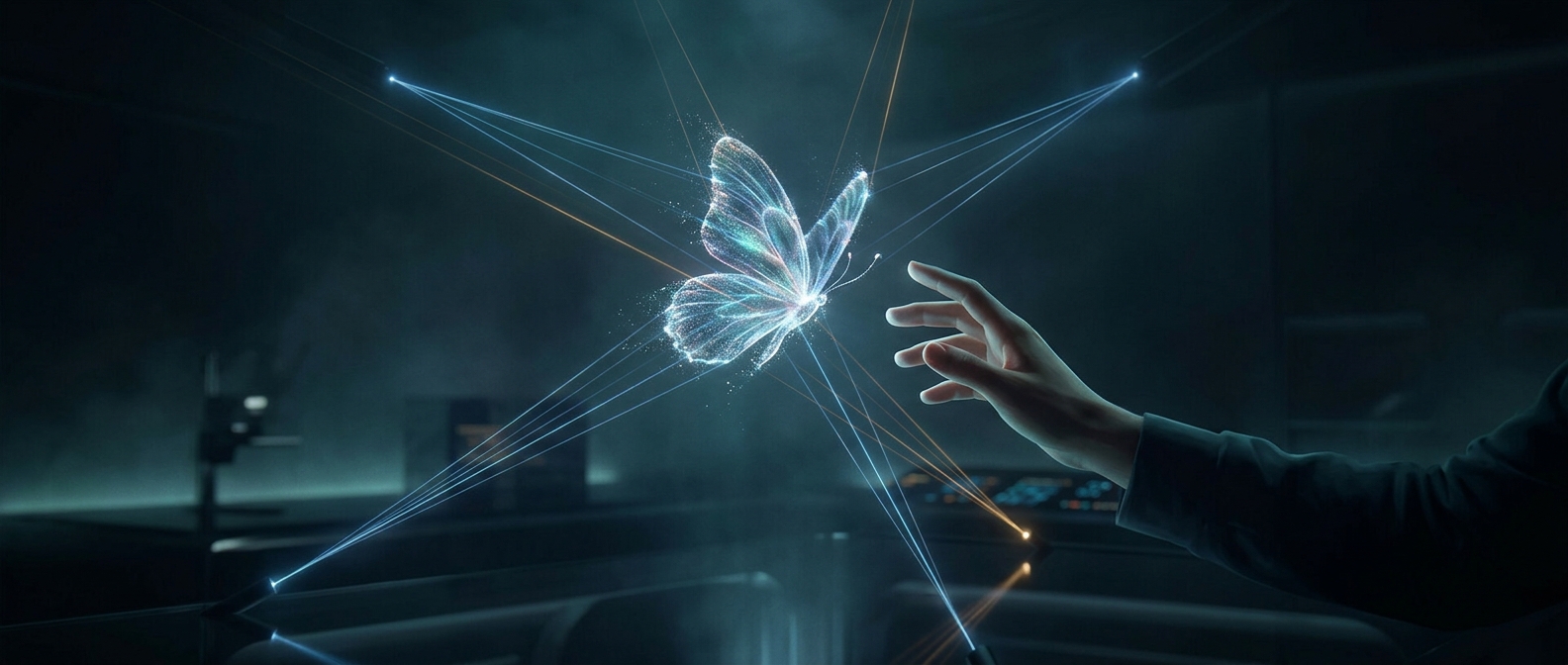
The trick depends on precise control. The particle must stay trapped as the beam moves, and its motion must be fast enough for the drawn structure to appear continuous. The visible image is therefore not simply a picture made by crossing two beams; it is the result of controlling where light is scattered, and when, throughout a volume of space.
That distinction is what makes the effect striking: a viewer can see a shape occupying empty air, while a hand could pass through the space it appears to fill.