Why a mirror keeps colors together
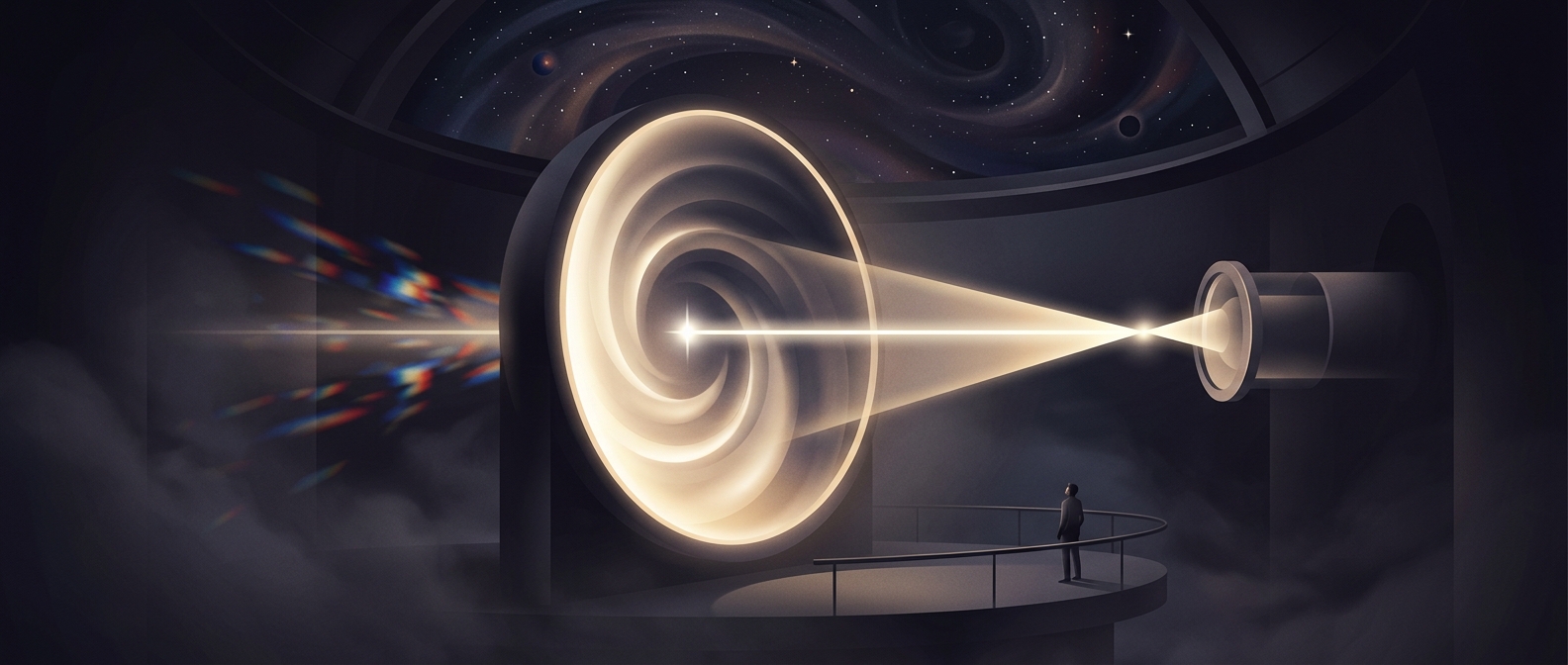
A lens bends light as it passes through glass. The amount of bending depends slightly on wavelength: blue light usually bends more than red. When a simple lens brings those colors to different focus points, a bright object can acquire colored fringes and lose sharpness. This effect is called chromatic aberration.
A mirror uses a different route. Light bounces off its reflective surface instead of traveling through a thick piece of glass, so the colors do not separate in the same way. The mirror curves to bring incoming rays toward a focus, and—under the same geometry—red and blue light follow nearly the same path. That makes mirrors especially useful when a telescope must gather light from faint, distant objects without creating color-split images.
Why the design scales up
A large lens has to be supported around its rim, while gravity can make its center sag. A telescope mirror can be supported from behind, giving engineers more ways to hold a broad, heavy surface in the precise shape needed for focusing. Large mirrors can therefore collect more light, which helps reveal dimmer objects and finer detail.
That does not make every mirror telescope automatically perfect. Its surface must be shaped with extreme precision, and additional mirrors or optical elements can introduce their own alignment and image-quality challenges. But by avoiding the basic color separation that occurs when light refracts through glass, a curved mirror solves one important problem at the heart of building powerful telescopes.