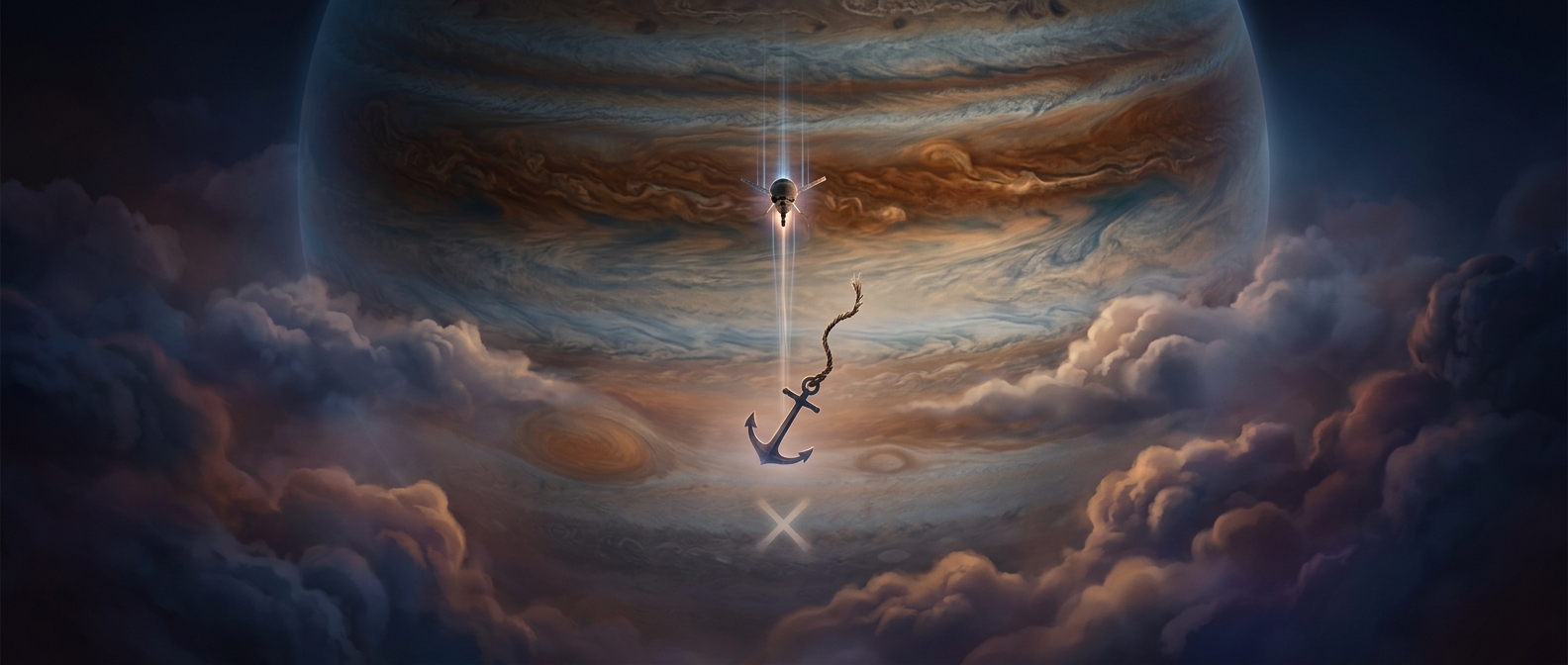
Why Jupiter has no place to land
On a rocky planet, the ground marks a sharp transition: above it is air, and below it is solid terrain. Jupiter is different. Its visible clouds are the tops of weather systems within an atmosphere, not a ceiling over a hidden landscape. There is no single altitude where that atmosphere stops and a solid exterior begins.
The deeper you go, the more the planet changes
A descent into Jupiter would pass through cloud layers made largely of ammonia, water, and other compounds. With increasing depth, the weight of the gas above compresses everything below. Pressure and temperature rise together, and the hydrogen becomes so dense that it behaves more like a fluid than a familiar gas.
Farther inward, hydrogen is compressed into a conducting state called metallic hydrogen. It is not a sheet of metal or a solid floor; it is hydrogen under immense pressure, able to conduct electricity. The planet’s powerful magnetic field is linked to motion in this electrically conducting interior.
No crisp boundary at the center
Jupiter may have a dense central region enriched with heavier elements, but scientists do not describe it as a neat, exposed rocky surface. The planet’s materials blend and change under pressure, so a probe would encounter progressively denser layers rather than a landing point. In practical terms, “going to the surface” of Jupiter is not a matter of finding the right place to touch down: the familiar distinction between air and ground simply does not apply.