A cloth inspection became a biological discovery
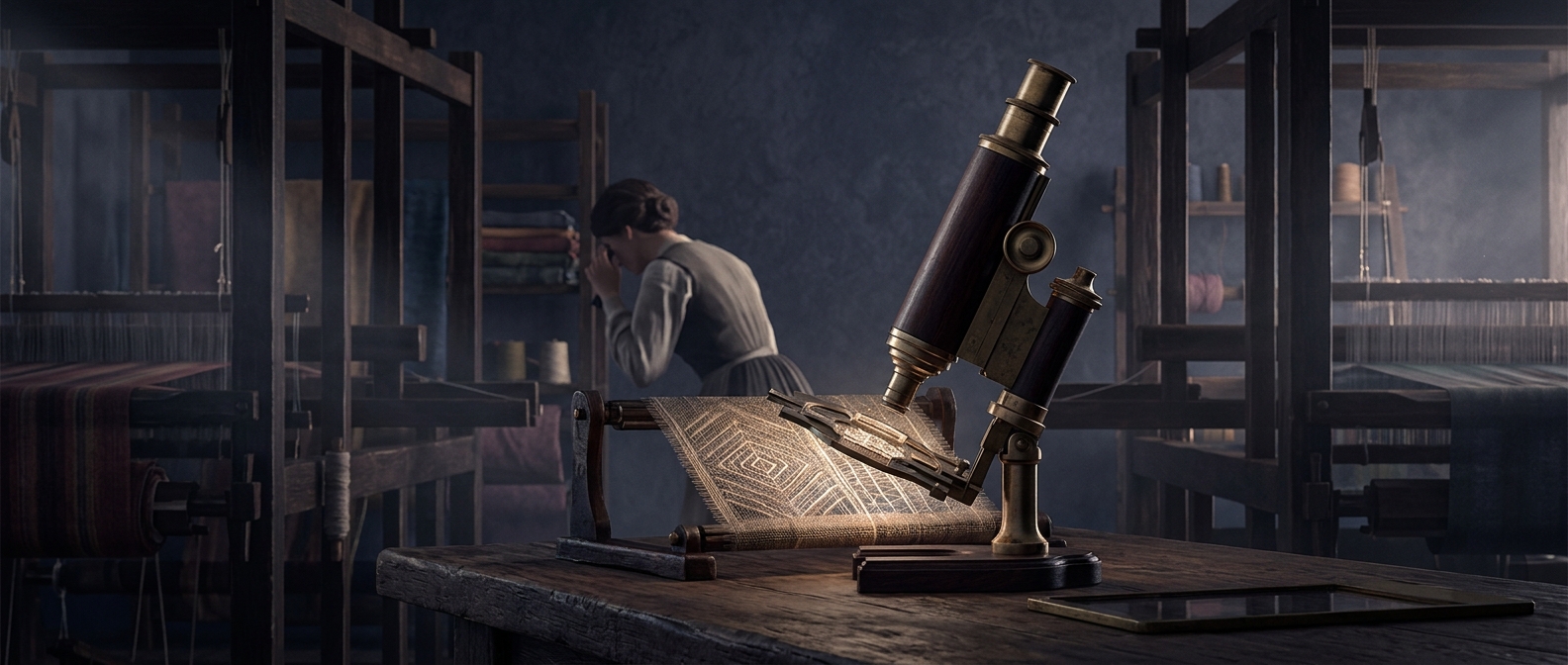
In 17th-century Delft, Antonie van Leeuwenhoek earned his living as a fabric seller. To judge the quality of cloth, he needed to inspect its weave closely. He made small, powerful magnifying lenses by grinding glass, then mounted them in simple devices that held a specimen near the lens and brought it into focus.
These were not modern compound microscopes, which use several lenses together. Leeuwenhoek’s single-lens instruments were difficult to use, but their magnification and clarity let him examine details that ordinary vision could not resolve.
From threads to “animalcules”
Looking closely at cloth was the practical starting point, not the limit of his curiosity. Leeuwenhoek turned his lenses toward drops of water and other samples. In them, he saw tiny living forms moving—organisms invisible without magnification. He called them “animalcules,” meaning little animals.
That observation mattered because it made a hidden scale of life directly visible. Before such instruments, people could not inspect these organisms for themselves; they might notice effects such as spoiled food or illness, but not the living agents in a sample. Leeuwenhoek’s observations helped establish that nature included a microbial world, though his lenses alone could not explain what those organisms did or how they caused disease.
A tool shaped by a trade
The route from fabric to microorganisms shows how an ordinary need can guide a major discovery. The lens was useful because it sharpened a seller’s view of thread; once the tool existed, it could be aimed at questions far beyond textiles. A device built to examine the visible quality of cloth revealed forms of life that had never been seen.